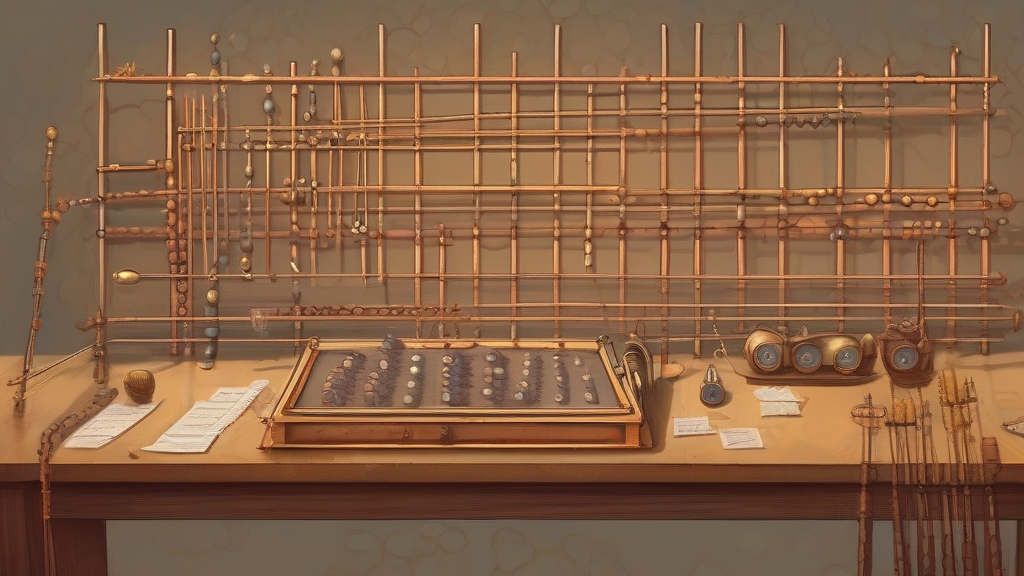
What does abac mean?
"Abac" is a rare English noun referring to a board, slab, or tablet — historically, a flat surface on which one could write, draw, or perform calculations. The word descends from the Greek "abax" (genitive "abakos"), meaning a board or slab, which also gave rise to the far more familiar "abacus," the counting frame whose beads slide along rods, as well as the architectural term for the flat stone atop a column capital. In practice, "abac" survives mainly in dictionaries, etymological writing, and descriptions of ancient or medieval reckoning boards, where merchants and scribes once moved counters or traced figures across its surface. Because it is so uncommon in everyday use, it carries no strong connotations of register beyond a scholarly or antiquarian flavor. Readers who meet the word should understand it as essentially an ancestor-term: a plain board that, fitted with counters and columns, became one of humanity's oldest calculating tools.
nounA rare word denoting a board, slab, or tablet; in historical usage it can refer to the flat surface or top plate of an abacus-like counting device.
- A board, slab, or tablet, especially one used as a surface for writing, drawing, or calculating.
- In historical and technical usage, the flat upper surface or plate associated with an abacus-type counting frame.
"The medieval merchant kept his tallies scratched into a wooden abac set upon the counter."
"The scribe smoothed the wax on his abac before pressing in the first letters."
"Early traders would calculate sums by moving counters across a ruled abac."
The plural simply adds -s; given the word's rarity, plural forms are seldom encountered outside scholarly contexts.
"The museum displayed several ancient abacs alongside early counting frames."
Before pocket calculators, merchants across the ancient world did their sums on a simple wooden board called an abac — the ancestor of today's abacus.
Reviewed by Deb Chak, Editor. AI-assisted content curated by RJS Tech Solutions LLP.
Etymology of abac
"Abac" derives from the Greek "abax" (genitive "abakos"), meaning a board or slab, a word the Greeks used for tablets on which calculations were performed with counters. Latin adopted the term as "abacus," from which English took both "abacus" and, more rarely, "abac." The same Greek root underlies the architectural sense of "abacus" — the square slab crowning a column capital — reflecting the original idea of a flat board or plate.
How abac is actually used
"Abac" is a genuinely rare and largely historical word; most modern readers will encounter it only in specialist dictionaries, etymological discussions, or archaic texts. It should not be treated as standard contemporary vocabulary, and writers seeking a current term will almost always want "abacus" instead.
Easily confused with abac
"Aback" is an adverb meaning backward or taken by surprise (as in "taken aback"), whereas "abac" is a rare noun for a board or tablet.
An "abacus" is a familiar counting frame or, in architecture, the flat slab atop a column capital; "abac" is a much rarer related term for such a board or surface itself.