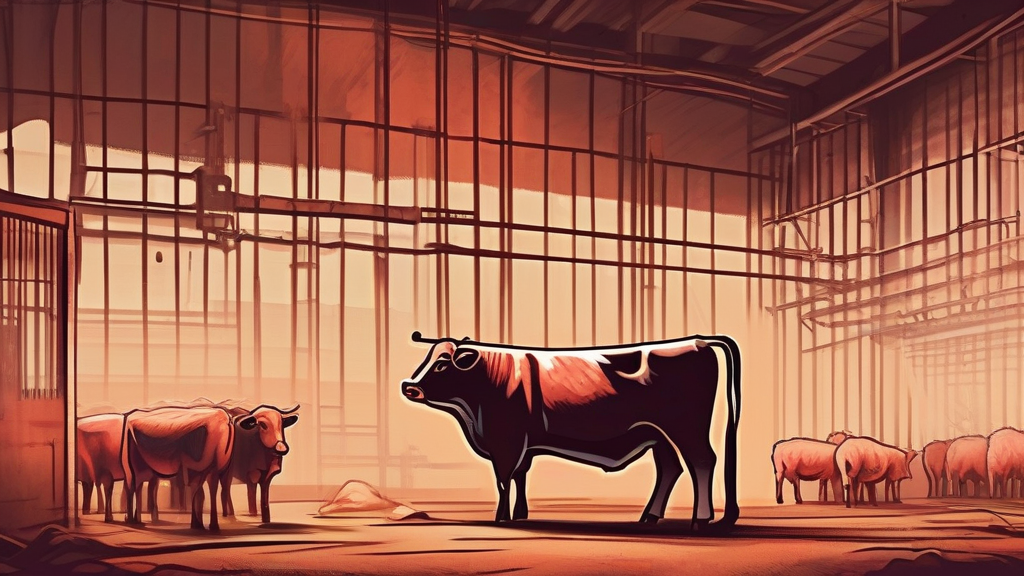
What does abattoir mean?
An abattoir is a facility where animals such as cattle, sheep, pigs, and poultry are slaughtered and processed into meat — in everyday speech, a slaughterhouse. The word entered English from French in the nineteenth century and carries a somewhat formal or technical tone, appearing most often in journalism, regulation, and industry writing rather than casual conversation. Because of its literal association with killing, 'abattoir' also lends itself to vivid figurative use: writers may describe a battlefield or a disastrous sporting defeat as an abattoir to evoke carnage and one-sided destruction. The word's French flavour gives it an almost genteel sound that contrasts sharply with its grim meaning, which is part of what makes it memorable. Related vocabulary includes terms like carcass, culling, and butchery, though these are not synonyms in the strict sense.
A building or premises where animals are slaughtered for food; a slaughterhouse.
"Cattle are transported to the abattoir early each morning."
More formal than 'slaughterhouse'; common in British English and in regulatory contexts.
(Figurative) A scene or place of widespread slaughter or carnage.
"Historians described the trench as a veritable abattoir during the offensive."
Literary or journalistic use; conveys extreme violence or one-sided slaughter.
Standard regular plural; used when referring to multiple facilities.
"Several abattoirs in the region have closed in recent years."
English borrowed 'abattoir' from French, where it literally means the place where cattle are 'felled' — and it's a cousin of the verb 'abate'.
Reviewed by Deb Chak, Editor. AI-assisted content curated by RJS Tech Solutions LLP.
Etymology of abattoir
Abattoir comes from French, derived from the verb abattre ('to fell' or 'to strike down'), which traces back through Old French to Vulgar Latin *abattere, from Latin ad- ('to, toward') plus battere ('to beat'). It thus originally denoted the place where cattle were felled for slaughter. English adopted the word in the early nineteenth century. Its Latin root also underlies related words such as 'abate' and, via Germanic borrowing into Romance, 'battle'.
How abattoir is actually used
Formal or technical in register; 'slaughterhouse' is the more everyday term. The figurative use describing scenes of carnage appears mostly in journalism and literary writing. Plural: abattoirs.
Easily confused with abattoir
'Abbatoire' is simply a misspelling of 'abattoir', which is the only correct spelling of the word.