What does butchery mean?
Butchery has two distinct meanings that share only their bloodiness. In its literal sense, it denotes the trade of slaughtering animals and cutting carcasses into meat, as well as the premises — the butcher's shop — where this work is done and meat is sold. In its figurative sense, it describes savage, indiscriminate killing on a large scale, a term journalists and historians reach for when describing massacres and the worst excesses of war. The word derives from the Old French "bocherie," rooted in a term for male goat, reflecting the medieval origins of the meat trade. While the craft sense is neutral, even admiring of skill, the figurative sense is unrelentingly grim, making butchery one of those rare words whose everyday and extreme uses sit uncomfortably close together. It remains common in British English and well understood throughout the English-speaking world.
The trade or practice of slaughtering animals and preparing their flesh for sale as meat.
"Butchery requires both anatomical knowledge and considerable knife skill."
This is the original and still-current literal sense.
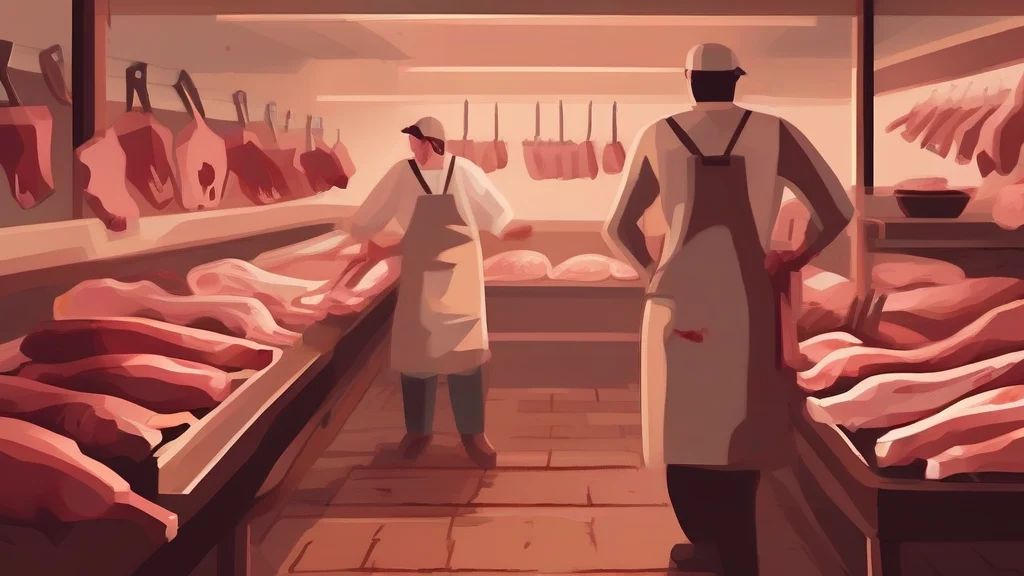
A shop or premises in which meat is slaughtered, cut, or sold.
"There's a good butchery just off the high street."
More common in British usage; American English favours "butcher shop."
Savage, indiscriminate slaughter of human beings.
"The general's tactics were condemned as sheer butchery."
Figurative; strongly negative register, typical of historical and journalistic writing.
The plural usually refers to multiple shops or instances of the trade; it can also denote repeated episodes of mass slaughter.
"Several family-run butcheries still thrive in the market town."
The word traces back to an Old French root meaning 'male goat' — so a butcher was originally, quite literally, a goat-slaughterer.
Reviewed by Deb Chak, Editor. AI-assisted content curated by RJS Tech Solutions LLP.
Etymology of butchery
Butchery comes from the Old French "bocherie," meaning the slaughtering of animals, derived from "boc," a word for male goat. The term passed into Middle English, where it came to mean both the meat trade and the premises where it was practised. The figurative sense — wholesale slaughter of people — developed later by analogy with animal slaughter. Cognates include the modern French "boucherie" and its derivative "bouchon."
Related word forms
How butchery is actually used
In modern British English, "butcher" more often refers to a person than "butchery" to a shop; Americans typically say "butcher shop" rather than "butchery" for the retail sense. The figurative sense — mass slaughter — carries strongly negative connotation and appears mostly in historical or journalistic writing about warfare.
Easily confused with butchery
"Butcher" is a person who cuts meat (or a verb meaning to kill clumsily), while "butchery" is the trade, place, or act itself.