
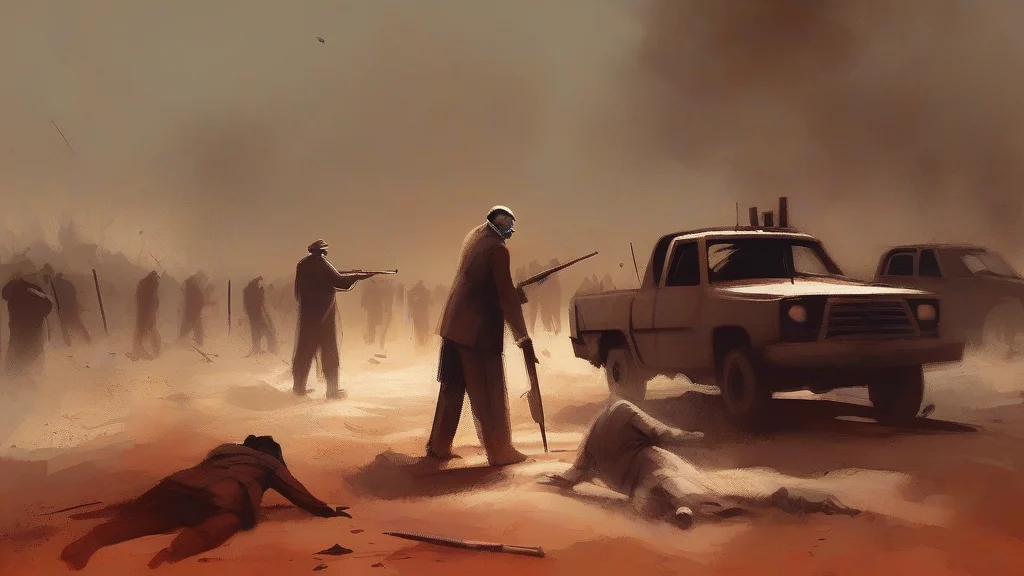
What does massacre mean?
Massacre is a powerful and serious word for the violent killing of many people, particularly those who are unarmed, defenseless, or not participating in the conflict. As a noun, it can refer to a single catastrophic event or to an act of large-scale killing. As a verb, it describes the deliberate or indiscriminate killing of a group. The word carries strong emotional and moral weight, distinguishing itself from more neutral terms such as killing and emphasizing the scale, brutality, and human cost of the event. It is also used figuratively in political and sporting commentary, where it can portray a crushing defeat or devastation. Because of its severity, massacre is usually reserved for situations involving extreme violence rather than ordinary casualties.
An event in which many people are killed violently, especially people who are unarmed, helpless, or not involved in the conflict.
"The report described the massacre and called for an independent investigation."
A highly negative term that emphasizes the scale and brutality of the killing.
To kill many people violently or brutally.
"The armed group was accused of massacring civilians in the village."
Usually used in historical, journalistic, or legal contexts and often paired with a group of people, such as civilians, villagers, or soldiers.
The regular plural is used for separate events or instances of mass killing.
"The history records massacres of civilians during the conflict."
The word’s power comes from its refusal to describe isolated violence: it names the moment when killing becomes collective, indiscriminate, and unforgettable.
Reviewed by Deb Chak, Editor. AI-assisted content curated by RJS Tech Solutions LLP.
Where does massacre come from?
The English word entered use in the early 16th century from French massacre. The French word was borrowed from Italian ammazzare, generally traced to Vulgar Latin *mactiare, derived from Latin mactare, meaning “to kill” or “to slaughter.” The same Latin root underlies English words such as mactation, mactator, and mactatory, while massacred, massacring, and massacrer continue the modern English derivational pattern.
Related word forms
How massacre is actually used
The word is strongly negative and usually denotes an exceptionally violent or indiscriminate killing. It is common in news, historical writing, legal contexts, and moral condemnation, but can sound emotionally charged when used figuratively for a severe defeat or destruction.