
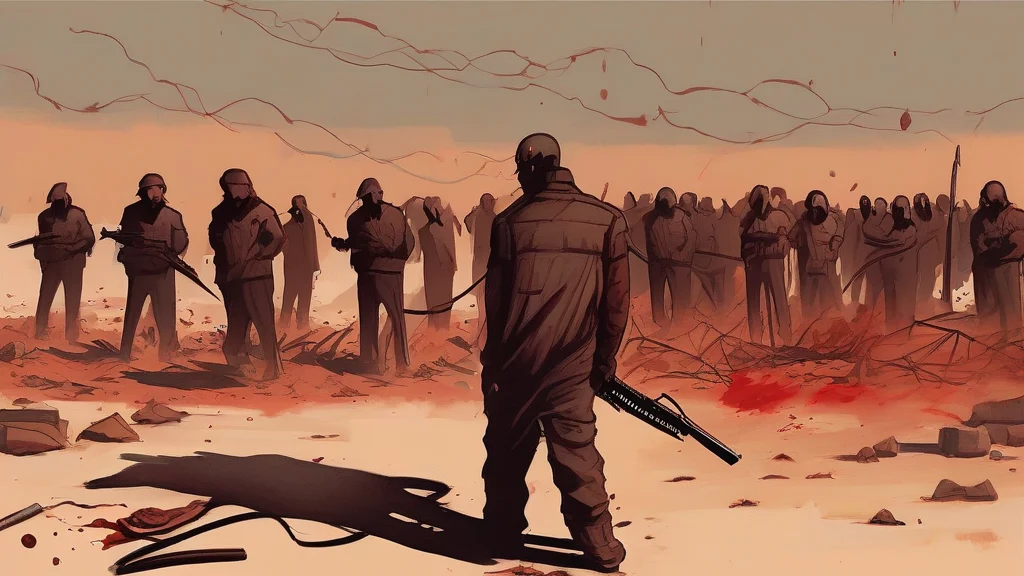
What does carnage mean?
Carnage is a noun referring to the大规模 slaughter of people, together with the bloody devastation such violence leaves behind. It is most often used to describe the human cost of war, massacres, terrorist attacks, and catastrophic accidents, as in 'the carnage of the First World War' or 'medics confronted scenes of carnage after the explosion.' The word is uncountable and belongs largely to formal registers — journalism, history writing, and official reports — where its gravity suits accounts of death and destruction on a significant scale. Its connotations are uniformly grim: it evokes not just killing but the visceral, chaotic aftermath of bloodshed. Figurative extensions exist, sometimes describing heavy losses in markets or sport, but these remain secondary. Etymologically, carnage traces back through French to the Latin caro, meaning 'flesh,' making it a relative of words like carnivore and incarnate. Its power lies in this physical imagery: carnage does not merely mean death, but the visible, flesh-and-blood wreckage that violence leaves behind.
nounThe violent killing of a large number of people, especially as seen on a battlefield or at the scene of an accident; widespread slaughter and the bloodshed that accompanies it.
- Large-scale slaughter or the bloody aftermath of violence, especially in war, battle, or a serious accident.
"Medics worked through the night amid the carnage left by the earthquake."
"The battlefield bore witness to terrible carnage, with casualties numbering in the thousands."
"Rescue workers described the carnage at the crash site as unlike anything they had ever seen."
Rarely used; carnage is almost always treated as an uncountable mass noun, so the plural appears only in unusual or literary contexts.
"Historians have catalogued the carnages of the twentieth century in exhaustive detail."
Carnage comes from the same Latin root as 'carnival' — one word celebrates the flesh, the other describes its destruction.
Reviewed by Deb Chak, Editor. AI-assisted content curated by RJS Tech Solutions LLP.
Etymology of carnage
Carnage entered English in the early 17th century, borrowed from French carnage, which derived from Italian carnaggio and ultimately from medieval Latin carnaticum ('tribute paid in meat'), built on the Latin caro, carnis meaning 'flesh.' The word's original association with the flesh of slaughtered bodies shaped its modern sense of mass slaughter and bloodshed. It shares this Latin root with words such as carnivore, carnival, incarnate, and carnal.
How carnage is actually used
Carnage is an uncountable noun used almost exclusively in serious or formal contexts such as journalism, history, and eyewitness accounts. It carries a strong connotation of horror and is generally too grave for casual use, though it is sometimes applied hyperbolically to non-lethal disasters or even figuratively to heavy losses (as in sports or finance) in journalistic style.
Easily confused with carnage
A carnival is a festive celebration or traveling fair, while carnage means large-scale slaughter — both derive from the Latin root for flesh, but their meanings are opposite in tone.
Carnal relates to bodily, especially sexual, appetites, whereas carnage refers to massive bloodshed and killing.