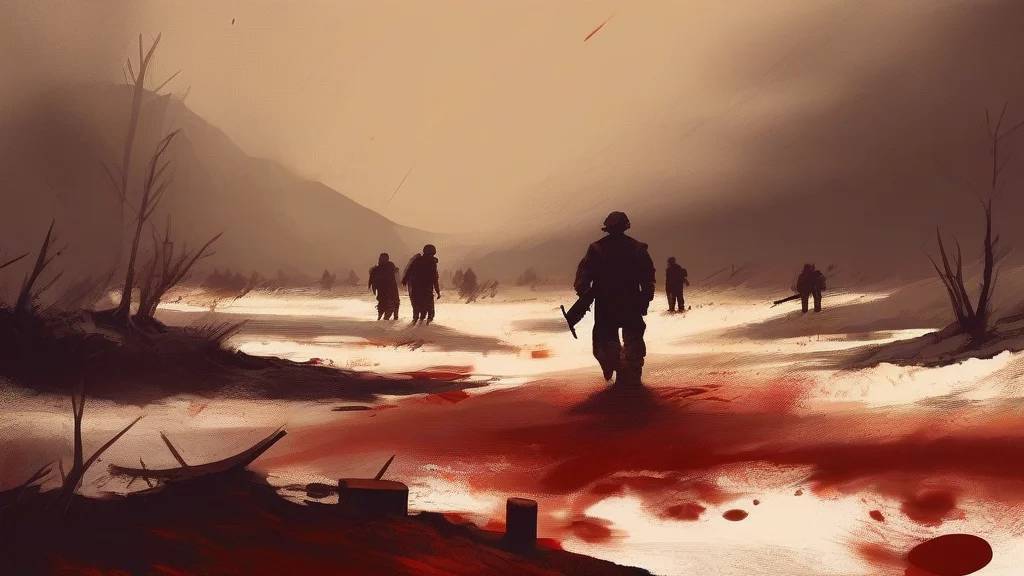
What does bloodshed mean?
Bloodshed is an uncountable noun referring to the spilling of blood through violence — most commonly the killing or wounding of people during wars, riots, uprisings, or other violent conflicts. The word combines 'blood' with 'shed,' the past form of the verb 'to shed,' meaning to pour out or let fall. Because it evokes scenes of carnage and loss of life, bloodshed carries heavy, somber connotations and belongs firmly to formal, journalistic, historical, and diplomatic registers rather than casual conversation. It appears most often in phrases stressing either the occurrence or the avoidance of violence: negotiators seek to end bloodshed, ceasefires are brokered to halt it, and successful interventions are praised for achieving their aims without bloodshed. The word is useful precisely because it condenses a broad range of violent outcomes — from individual deaths to large-scale massacre — into a single, gravely resonant term.
nounThe shedding of blood, especially violent killing or wounding of people, as in war or conflict; blood spilled through violence.
- The shedding or spilling of blood through violence, especially killing or wounding in war, riot, or conflict.
- (Figurative, less common) Violent conflict or strife more generally, as in 'a dispute resolved without bloodshed.'
"The treaty was signed at last, bringing an end to years of bloodshed."
"Negotiators worked through the night to end the bloodshed between the two factions."
"Thankfully, the police managed to disarm the suspect without any bloodshed."
Bloodshed is an uncountable noun and does not take a plural form. Quantity is expressed with modifiers such as 'much,' 'widespread,' or 'further.'
"Much bloodshed could have been avoided had the ceasefire held."
Despite sounding ancient, 'bloodshed' is a compound English word — literally 'blood' + 'shed' — that has described humanity's worst moments for centuries.
Reviewed by Deb Chak, Editor. AI-assisted content curated by RJS Tech Solutions LLP.
Etymology of bloodshed
Bloodshed is formed from two native Germanic elements: 'blood' (Old English blōd) and 'shed' (from Old English scēadan, meaning to divide or separate, which developed the sense of pouring out or spilling). The compound arose within Middle or early Modern English as a direct calque-like formation describing the letting of blood in combat. It has no Latin or Greek root, but it shares its Germanic ancestry with related compounds such as bloodbath, bloodletting, and bloodstain, all built on the same first element. The word has been in continuous use for centuries, particularly in chronicles of war and political upheaval.
How bloodshed is actually used
Bloodshed is an uncountable noun used almost exclusively in serious, often formal or journalistic contexts to describe violence resulting in injury or death. It carries strongly negative connotations and frequently appears in phrases emphasizing the avoidance or cessation of violence ('without bloodshed,' 'to prevent further bloodshed'). It is not used for trivial injuries or minor accidents.
Easily confused with bloodshed
Bloodshed refers to the spilling of blood through violence, while bloodshot describes eyes with reddened, dilated blood vessels.
Bloodshed denotes violent blood-letting, whereas bloodline refers to a line of ancestry or family descent.