
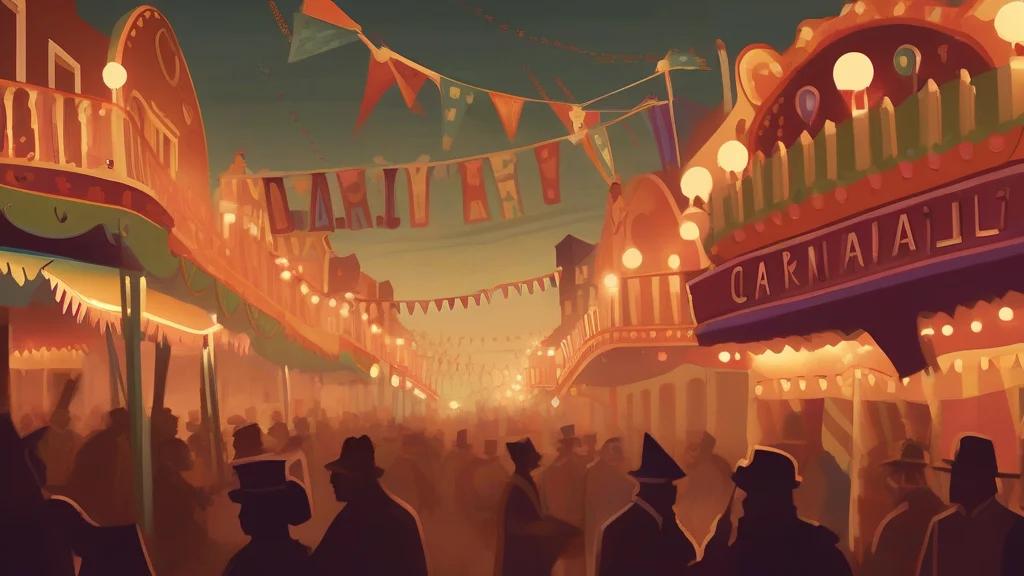
What does carnival mean?
Carnival is an annual period of public festivity and revelry celebrated immediately before Lent, the Christian season of fasting and penitence that begins on Ash Wednesday. Traditionally observed with parades, masks, costumes, music, dancing, and abundant food, carnival is especially associated with Roman Catholic regions such as Brazil, Italy, and parts of the Caribbean, where events like the Rio Carnival, Venice Carnival, and Trinidad Carnival draw millions of participants. In North America the word also commonly denotes a travelling amusement fair with rides, games, and sideshows. Figuratively, carnival describes any scene of wild, colourful excitement — 'a carnival of noise'. The word derives from medieval Latin carnem levare, 'to remove meat', reflecting its role as a last indulgence before dietary abstention. It evokes joy, excess, and a brief suspension of everyday rules, making it a vivid term for both literal festivals and metaphorical uproar.
nounA period of public revelry, feasting, and processions held annually before Lent, especially in Roman Catholic countries. More generally, any lively festival, fair, or celebration featuring entertainment, music, and amusement rides.
- The festive season immediately preceding Lent, marked by parades, costumes, feasting, and public celebration, especially in Catholic countries such as Brazil, Venice, and New Orleans.
- A travelling fair or amusement event with rides, games, sideshows, and food stalls (chiefly North American usage).
- A lively, chaotic scene or atmosphere resembling such festivities — often used figuratively, as in 'a carnival of colour' or 'media carnival'.
"The streets of Rio de Janeiro erupt into a dazzling carnival every February."
"Venice transforms each winter as masked revellers flood the canalside squares during carnival."
"The children spent the whole afternoon at the carnival, winning goldfish and riding the Ferris wheel."
Regular plural; typically used when referring to multiple distinct festivals or travelling fairs.
"The company operates several travelling carnivals across the Midwest each summer."
Carnival literally means 'removal of meat' — a final farewell to flesh and feasting before Lent's fasting begins.
Reviewed by Deb Chak, Editor. AI-assisted content curated by RJS Tech Solutions LLP.
Etymology of carnival
The word carnival entered English in the mid-16th century from Italian carnevale, which traces back through Medieval Latin to the phrase carnem levare, meaning 'to remove meat' — a reference to the abstention from meat during Lent. This root is shared with Latin caro, carn- ('flesh'), which also gives English words such as carnal, incarnate, and carnation. The term spread across European languages alongside the pre-Lent festivities themselves, later extending by analogy to fairs and travelling amusements, particularly in North America.
How carnival is actually used
In British English 'carnival' most often refers to the pre-Lent festival or large street celebrations such as Notting Hill Carnival; in American English it frequently means a travelling funfair. The word carries connotations of exuberance, indulgence, and temporary inversion of ordinary social order. Capitalise in proper names (e.g., Rio Carnival).
Easily confused with carnival
'Carneval' is simply a variant spelling used in some languages (such as German); the standard English spelling is 'carnival'.