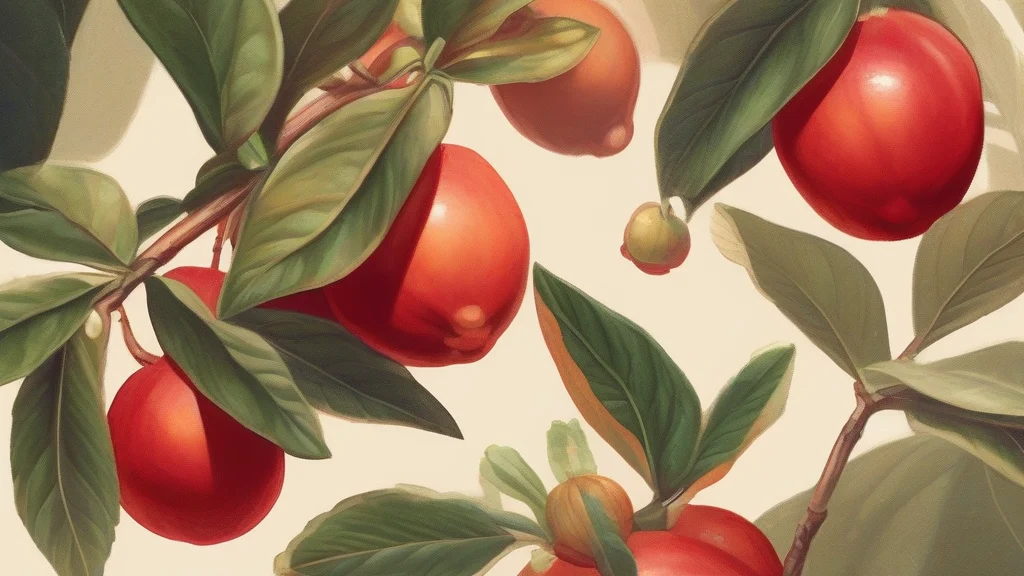
What does acerola mean?
Acerola is a small, glossy, bright red fruit produced by a tropical shrub of the genus Malpighia, native to the West Indies, Central America, and northern South America. Also widely known as the Barbados cherry or West Indian cherry, it is cultivated throughout warm regions of the Americas and beyond. Although sweet-tart and pleasant to eat fresh, acerola is remarkably perishable, so it reaches most consumers as juice, pulp, preserves, or dried powder. Its chief claim to fame is nutritional: the fruit contains extraordinarily high levels of vitamin C — far more than citrus by weight — which has made it a popular ingredient in supplements, health drinks, and fortified foods. The word entered English through Spanish and remains most at home in culinary, agricultural, and wellness writing. For readers interested in nutrition or tropical fruits, acerola is a useful term to know, denoting one of nature's richest natural sources of this essential vitamin.
nounA small, bright red tropical fruit of the shrub Malpighia emarginata, native to the West Indies and northern South America, prized for its exceptionally high vitamin C content; also called the Barbados cherry.
- The edible red fruit of Malpighia emarginata, valued chiefly for its very high vitamin C content.
- The tropical shrub or small tree itself that bears this fruit.
"The smoothie was boosted with a scoop of acerola powder for an extra dose of vitamin C."
"Farmers in Puerto Rico harvest acerolas when they turn a deep crimson, as the fruit does not ripen well off the tree."
"The supplement label listed acerola extract among its natural sources of vitamin C."
Standard plural; the singular may be retained in attributive uses such as 'acerola juice'.
"The market stalls were piled high with ripe acerolas."
One tiny acerola can pack more vitamin C than an entire orange — up to fifty times as much by weight.
Reviewed by Deb Chak, Editor. AI-assisted content curated by RJS Tech Solutions LLP.
Etymology of acerola
The word acerola came into English from Spanish, in which it names the fruit of the West Indian cherry tree. It was borrowed into English during the nineteenth century as trade in the fruit and interest in tropical agriculture spread from the Caribbean. The Spanish term is often linked to earlier Iberian words for related sour cherries, though the precise pre-Spanish origin of the form is debated, so any deeper root should be treated with caution.
How acerola is actually used
Acerola is used mainly in food, nutrition, and horticultural contexts rather than everyday conversation. In commercial usage it most often appears in compounded forms such as 'acerola cherry', 'acerola juice', or 'acerola powder'. The plural is typically 'acerolas'; the fruit name is sometimes left unpluralized when used attributively.