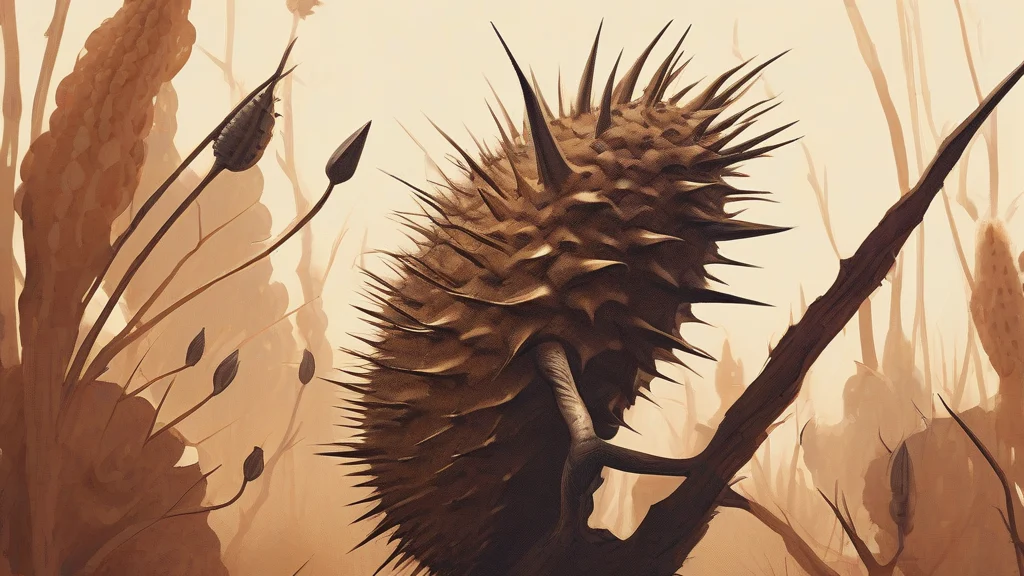
What does aculeated mean?
"Aculeated" is a formal adjective used mainly in biology to describe organisms that are covered with or armed with prickles, spines, or other sharp, needle-like structures. It appears most often in botany, where it characterizes thorny or bristled plants, and in entomology, where it describes stinging insects such as bees and wasps. The word derives from the Latin "aculeus," meaning a sting or prickle, itself a diminutive of "acus," meaning needle — making it a close relative of familiar words like "acute" and "acupuncture." Because of its technical flavor, it rarely surfaces in casual conversation, but it offers writers a precise, evocative alternative to plainer terms like "prickly" or "spiny" when describing anything armored with fine, sharp points. Its variant form "aculeate" carries the same meaning and is somewhat more common in modern scientific usage.
adjectiveCovered with or bearing prickles, stings, or sharp points; in zoology and botany, armed with needle-like structures such as spines or a sting.
- Covered with or armed with prickles, spines, or sharp points (used especially of plants and animals).
- In entomology, belonging to or characteristic of insects possessing a sting.
"The entomologist handled the aculeated wasp with great care."
"The cactus's aculeated surface deterred even the hungriest desert rodents."
"She noted in her field journal that the species was distinctly aculeated, its abdomen tipped with a formidable sting."
It shares an ancient root with "acupuncture" and "acute" — all trace back to the Latin word for needle, so an aculeated insect is literally "needled" all over.
Reviewed by Deb Chak, Editor. AI-assisted content curated by RJS Tech Solutions LLP.
Etymology of aculeated
"Aculeated" comes from the Latin "aculeatus," meaning "prickly" or "armed with a sting," derived from "aculeus," a sting or sharp point, which is itself a diminutive of "acus," meaning needle. The same Latin root gives English "acute," "acumen," and "acupuncture." The word entered English as part of the learned vocabulary adopted from Latin during the early modern period, alongside its shorter variant "aculeate."
Related word forms
How aculeated is actually used
A technical term found chiefly in scientific writing — botany, zoology, and especially entomology — rather than everyday speech. It carries a formal, descriptive register and no strong emotional connotation.
Easily confused with aculeated
"Aculeate" is the simpler adjective meaning prickle-bearing (and a noun for a stinging insect), while "aculeated" is its longer variant form carrying the same sense.
"Accumulated" means gathered or piled up over time, whereas "aculeated" describes something physically covered with prickles or stings.