What does barbed mean?
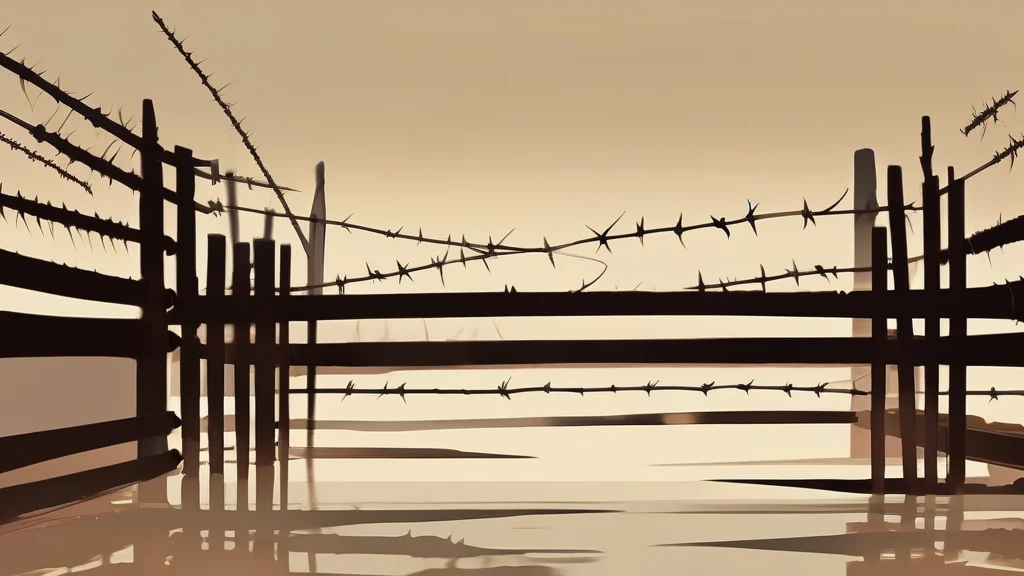
Barbed describes something equipped with a barb: a sharp point angled backward toward its base, engineered to grip and resist removal. Its most iconic embodiment is barbed wire, invented in the 1870s, whose twisted strands transformed farming, warfare, and border control across the world; fishhooks, harpoons, and hunting arrows are likewise barbed for the same reason. The word has also developed a figurative life: a 'barbed remark' is one whose surface politeness conceals a sting that is hard to dislodge once delivered, just as a barbed hook is hard to pull free. This dual character makes 'barbed' a vivid choice for writers — concrete when describing hardware, pointed when describing wit. Derived from Latin through Old French, it shares deep roots with words like 'barbarous.' Whether applied to fencing or to criticism, it reliably signals something designed not merely to pierce, but to hold on.
Having a barb or barbs: sharp points turned backward near the tip, as on a hook, arrow, or length of twisted wire.
"The archer inspected every barbed arrowhead before the hunt began."
In this literal sense the word is technical and neutral.
(Of a remark, comment, or tone) sharply critical or stinging, often under a veneer of civility.
"He offered a barbed compliment about how rarely her predictions proved correct."
This figurative sense implies deliberate hostility rather than mere frankness.
The same Latin root that gave us 'barbed' also gave us 'barbaric' — to ancient ears, a foreigner's speech sounded like 'bar-bar,' mere babbling.
Reviewed by Deb Chak, Editor. AI-assisted content curated by RJS Tech Solutions LLP.
Etymology of barbed
The adjective 'barbed' derives from the noun 'barb,' which came into English from French 'barbe' in the late sixteenth century, ultimately from Latin 'barba,' meaning 'beard' — a barb's bristling points resembling a beard's stiff hairs. The same Latin root produced 'barbarous' and 'barbaric,' since Greek speakers heard foreign languages as unintelligible 'bar-bar' sounds. The figurative sense describing cutting remarks developed from the literal one, borrowing the image of a point that lodges in flesh and resists extraction.
Related word forms
How barbed is actually used
'Barbed' is most strongly associated with barbed wire, so much so that the phrase often stands alone. When used of language — as in 'a barbed remark' — it carries a deliberately hostile or mocking connotation and sits at the informal-to-literary end of register. The literal sense is neutral and technical.
Easily confused with barbed
A beard is hair growing on the lower part of a man's face, while 'barbed' describes something with backward-facing sharp points or cutting remarks.