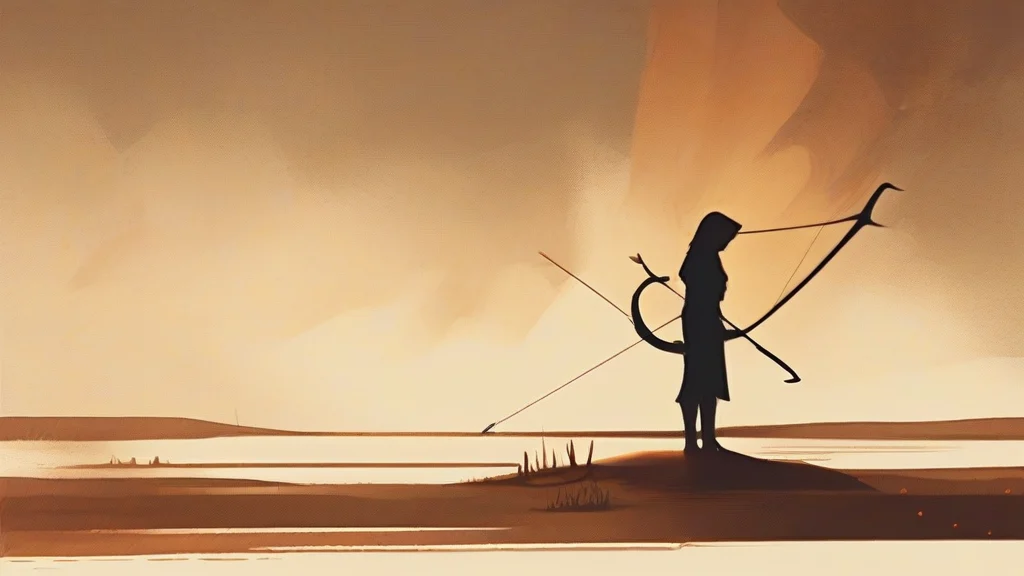
What does barb mean?
A barb is, most literally, a backward-angled point set near the tip of an arrowhead, fishhook, or dart — a design feature whose whole purpose is to lodge: once embedded, it resists being pulled free. That physical quality gives the word its vivid figurative life. A barb in speech is a remark deliberately sharpened to wound, one that lodges in memory much as a hooked point lodges in flesh. The word also has precise technical uses: in ornithology, barbs are the fine filaments branching from a feather's central shaft that interlock to form the smooth vane, and the hollow base of that shaft is likewise called the barb. Derived forms include the adjective barbed, describing anything fitted with such points — from barbed wire to barbed commentary — and barbless, common in fishing regulations. Whether describing tackle, feathers, or a well-aimed insult, barb consistently connotes something that catches and is not easily shaken off.
A backward-pointing projection near the head of an arrow, fishhook, or similar object, designed to prevent easy withdrawal.
"Anglers often pinch down the barb of a hook to make catch-and-release safer for the fish."
In modern fishing, 'barbless' hooks are mandated in many fisheries to reduce injury to released fish.
A cutting, stinging, or wounding remark; a pointed insult delivered with precision.
"His farewell speech was laced with barbs aimed at his former business partners."
This figurative sense is standard and widely understood in both British and American English; it always implies intentional sharpness.
One of the numerous slender filaments branching from each side of a feather's shaft, which interlock to form the vane; also, the hollow basal portion of the shaft.
"Under magnification, tiny hooklets could be seen linking each barb to its neighbours along the feather."
Primarily used in ornithology and technical writing about feathers.
Standard plural; commonly used when referring collectively to the points on multiple hooks or arrows, or to a series of cutting remarks.
"The interview was remembered less for his answers than for the barbs he traded with the host."
Every time someone's insult 'stings and lingers,' they've deployed a barb — the same word that names the backwards-pointing spike designed to stay stuck in flesh.
Reviewed by Deb Chak, Editor. AI-assisted content curated by RJS Tech Solutions LLP.
Etymology of barb
Barb entered English from French barbe, which itself derives from Latin barba, meaning beard. The original sense was likely the projecting points of a beard-like or bristling character, which extended naturally to the hooked projections of arrows and fishhooks by the late Middle Ages. The same Latin root gave rise to related English words including barbel (the whiskered fish), barbican (a fortified outpost), and barberry (a prickly shrub), all reflecting notions of bristling or bearded projections. The figurative sense of a stinging remark developed later, drawing on the image of a point that pierces and holds.
Related word forms
How barb is actually used
As a figurative noun, barb almost always carries negative connotation, implying deliberate sharpness rather than casual criticism. In angling contexts, barbless hooks are often required by catch-and-release regulations. The feather-anatomy sense is technical and largely confined to ornithology.
Easily confused with barb
Barbe is an obsolete term for a woman's linen veil or wimple covering neck and chin, whereas barb is either a backward-facing point on a weapon or hook, or a stinging remark.
The Barb is a breed of light riding horse from North Africa, unrelated to the noun barb meaning a hook point or a cutting remark.