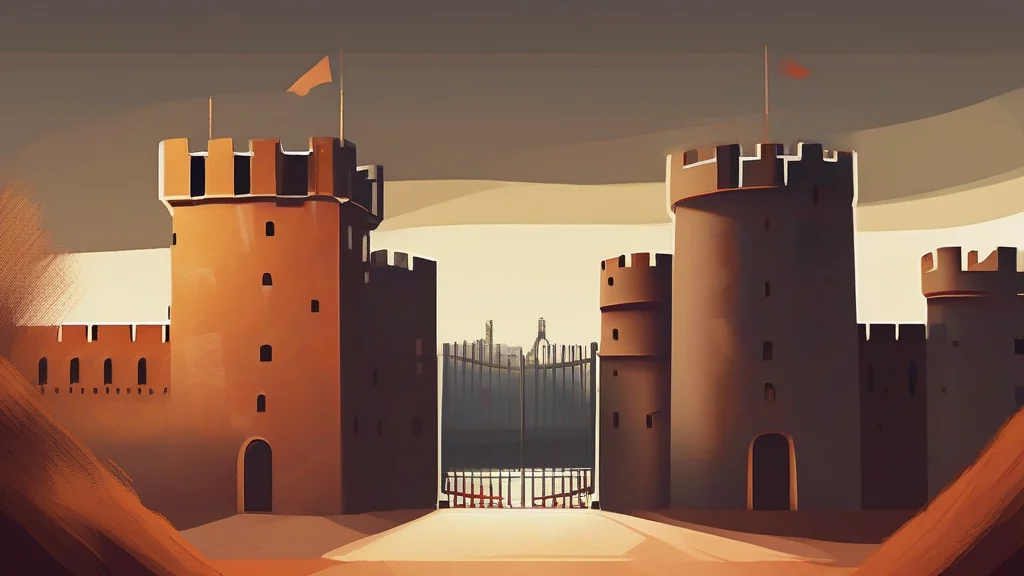
What does barbican mean?
A barbican is a fortified structure built to defend the entrance to a castle or walled town. Typically an outwork placed in front of the main gate — sometimes a freestanding tower, sometimes a walled passage — it forced attackers to negotiate an additional line of defence before reaching the gatehouse itself. Many surviving examples can be seen at British and European castles, where the barbican often forms the first stage of a visitor's route today. The word belongs chiefly to the vocabulary of military architecture and history, so it appears most naturally in guidebooks, heritage writing, and accounts of medieval warfare. Beyond its literal sense, the term survives prominently as a proper noun: London's Barbican Centre, a major arts complex, occupies ground once defended by a medieval barbican of the same name. For readers of history or enthusiasts of castles, 'barbican' is a precise and evocative term for one of the most recognisable features of fortified design.
nounA fortified outpost or gateway, such as an outer defence of a castle or city wall, especially one protecting a gate or drawbridge.
- A fortified outwork or tower defending a castle or city gate, typically positioned in front of the main entrance.
- (By extension, rare) Any projecting defensive structure at an entrance or gateway.
"The attackers were forced to breach the barbican before they could reach the castle's main gate."
"Visitors to the castle still pass through its thirteenth-century barbican before reaching the inner ward."
"The city's medieval walls were strengthened with a barbican guarding the river gate."
Standard regular plural; used when referring to multiple fortifications, e.g. across different castles or sites.
"The region's castles are notable for their well-preserved barbicans."
London's brutalist Barbican Centre takes its name from a medieval watchtower that once guarded the very same spot — concrete built on stone.
Reviewed by Deb Chak, Editor. AI-assisted content curated by RJS Tech Solutions LLP.
Etymology of barbican
The word 'barbican' entered English in the Middle Ages from Old French 'barbacane', which itself was borrowed from medieval Latin 'barbacana'. The ultimate origin is usually traced to Persian, via Arabic 'bab khanah' ('gate house') or a related Persian term for a fortified gateway, though the exact route remains debated among scholars. Cognates appear across European languages, including Spanish 'barbacana' and Italian 'barbacane', reflecting how widely the feature — and the word — spread with medieval fortification.
How barbican is actually used
The word is largely historical and architectural, appearing most often in descriptions of castles, city walls, and heritage sites. It carries no negative connotation but sounds formal and archaic outside these contexts. In Britain it is also strongly associated with the Barbican Centre in London through the proper noun.
Easily confused with barbican
The Barbican is also the name of a famous performing-arts centre and residential estate in the City of London, built on the site of the Roman fort's old barbican — the common noun refers to the medieval fortification itself.