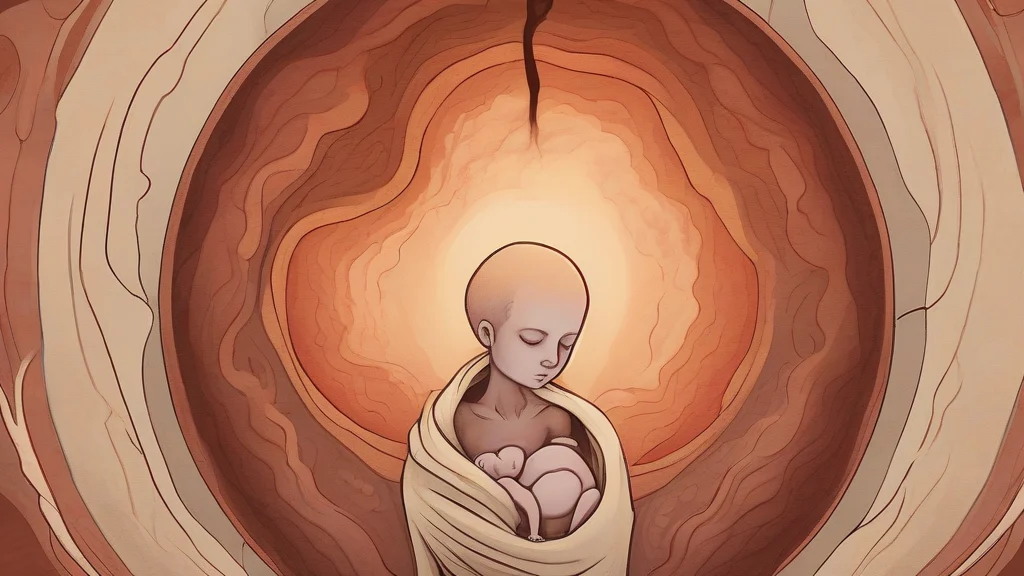
What does afterbirth mean?
Afterbirth refers to the placenta and associated fetal membranes that are expelled from the uterus shortly after a baby or other offspring is delivered. It is a standard term in obstetrics, midwifery, and veterinary medicine, where confirming that the afterbirth has been fully expelled is an important part of postpartum care, since retained tissue can lead to infection or hemorrhage. In everyday speech the word appears most often in discussions of animal births, farming, and natural childbirth contexts. Clinicians today often favor the more precise term 'placenta', but 'afterbirth' remains widely understood and carries no strong connotation beyond its literal meaning. A rare, largely historical figurative use treats it as any by-product left behind after a main event. The word derives simply from 'after' plus 'birth', reflecting exactly what it describes: what comes after the birth.
nounThe placenta and fetal membranes that are expelled from the uterus after the birth of a baby.
- The placenta and fetal membranes expelled from the uterus after childbirth.
- Loosely, anything that follows or comes after something else as a by-product.
"After the delivery, the midwife examined the afterbirth to confirm it was complete."
"The cow licked her calf clean while the afterbirth was still being passed."
"Veterinarians check that the entire afterbirth has been expelled to prevent infection in the mother."
Rarely pluralized since each birth typically produces one; the plural may appear when referring collectively to multiple births.
"The vet inspected the afterbirths of both newborn lambs."
In many mammal species — including some traditional human cultures — eating the afterbirth (placentophagy) is a real, documented practice.
Reviewed by Deb Chak, Editor. AI-assisted content curated by RJS Tech Solutions LLP.
Etymology of afterbirth
Afterbirth is a straightforward English compound formed from 'after' + 'birth', first attested around the late 16th to early 17th century. It belongs to the Germanic root of 'birth' (Old Norse 'byrð', related to Old English 'gebyrd'), making words like 'born' and 'midwife' distant relatives of its core element. Unlike many medical terms, it was coined natively in English rather than borrowed from Latin or Greek, which is why it sits alongside Latinate clinical terms like 'placenta' (from Latin for 'flat cake').
How afterbirth is actually used
Primarily used in medical, veterinary, and midwifery contexts; clinical settings increasingly prefer the more precise term 'placenta'. The figurative sense ('anything following as a by-product') is rare and somewhat dated.
Easily confused with afterbirth
The placenta is the organ itself; 'afterbirth' is a broader term for the placenta plus the fetal membranes expelled after delivery.