What does agateware mean?
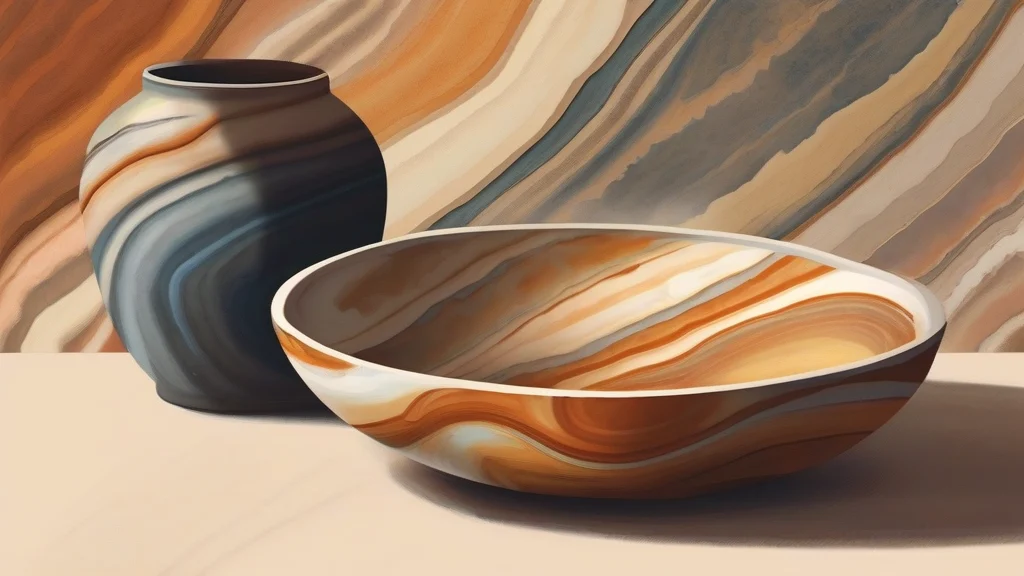
Agateware is a type of ceramic ware distinguished by its marbled, banded surface, created by blending together clays of different natural colors — typically whites, reds, browns, and grays — before the piece is shaped and fired. The name comes from its resemblance to agate, the semiprecious stone prized for its concentric colored bands. The technique was especially popular among English potters in the eighteenth century, notably in Staffordshire, where it was used for teapots, jugs, snuffboxes, and ornamental figures. Because each piece carries unique swirls and veins, no two examples are exactly alike, which has long appealed to collectors. Today the term appears chiefly in the vocabulary of antiques, ceramics, and decorative arts, where it signals both a specific manufacturing method and a distinctive aesthetic of swirled, earthy patterning.
nounPottery or earthenware decorated with variegated, marbled bands of differently colored clays so as to resemble the banded semiprecious stone agate.
- Ceramic ware whose body is made from blended clays of different colors, producing a marbled or banded effect resembling agate.
"The museum's collection included a rare eighteenth-century teapot of finely veined agateware."
"She displayed her grandmother's agateware mixing bowls on the kitchen shelf."
"Collectors of English pottery often seek out agateware snuffboxes for their swirling veins of brown, red, and cream."
Rarely used; the plural appears mainly in scholarly or cataloguing contexts referring collectively to multiple pieces or types of such ware.
"The exhibition brought together agatewares from several eighteenth-century Staffordshire workshops."
Potters in eighteenth-century Staffordshire kneaded clays of different colors together just to make cheap ceramics look like an expensive gemstone — and collectors still prize the results today.
Reviewed by Deb Chak, Editor. AI-assisted content curated by RJS Tech Solutions LLP.
Etymology of agateware
The word agateware combines 'agate', the name of the banded gemstone, with 'ware', a long-established English term for manufactured goods. The stone's name traces back through Latin 'achates' to Greek 'akhātēs', a word the ancient Greeks associated with the river Achates (now the Drillo) in Sicily, where the stones were found. Potters adopted the term because their marbled wares visually imitated the stone's characteristic banding, and the compound became established in English ceramic terminology during the eighteenth century.
How agateware is actually used
Agateware is a specialist term used mainly in discussions of ceramics, antiques, and decorative arts. It refers to the material and its distinctive marbled technique rather than to any particular shape of vessel.
Easily confused with agateware
Agate is the banded semiprecious gemstone itself, while agateware is pottery made to imitate that stone's marbled appearance.