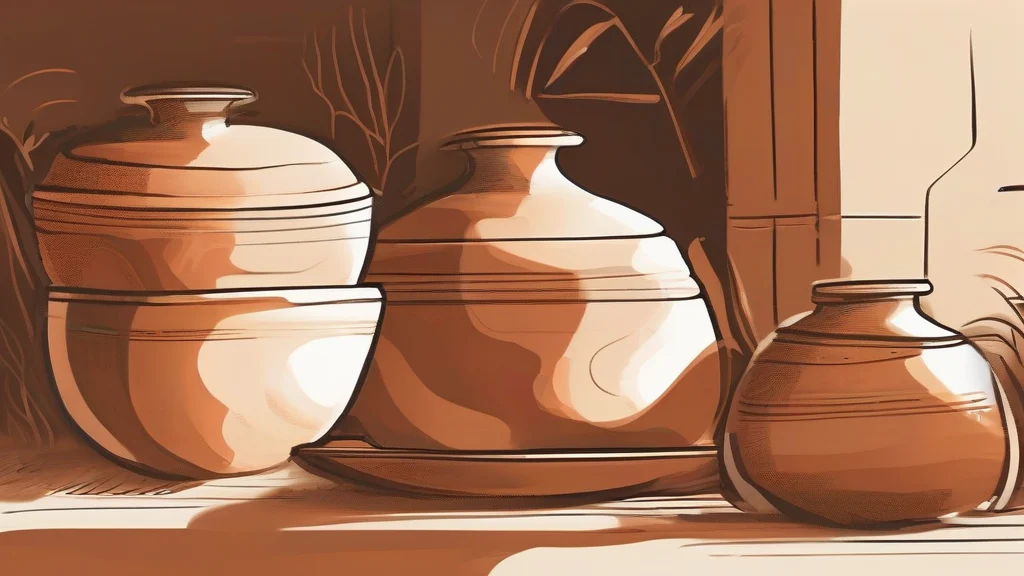
What does earthenware mean?
Earthenware is a type of pottery made from ordinary clay that has been shaped and then hardened by firing at comparatively low temperatures, generally below about 1200°C. Because of this gentle firing, the resulting material is relatively soft and remains porous unless it has been coated with a glaze — one reason earthenware vessels are so often brightly glazed or decorated. The word refers both to the material itself and, as a collective term, to the dishes, jugs, bowls, and tiles made from it. Earthenware is among the oldest and most widespread forms of ceramic, produced across the world since prehistoric times, and it includes well-known traditions such as terracotta, majolica, delftware, and faience. Compared with denser stoneware and refined porcelain, earthenware carries connotations of rustic charm and everyday domestic use rather than luxury. It functions as an uncountable noun and appears frequently in discussions of cooking, archaeology, and decorative craft.
nounEarthenware is pottery made from clay that is fired at a relatively low temperature, remaining somewhat porous unless glazed. It also refers collectively to dishes, vessels, and other objects made of this material.
- Pottery made of clay fired at relatively low temperatures (typically below about 1200°C), remaining porous unless glazed.
- Dishes, pots, and other objects made of this material, considered collectively.
"The shelves were lined with hand-painted earthenware bowls in deep blues and greens."
"The archaeologists recovered fragments of glazed earthenware from the medieval kitchen site."
"She served the stew in a rustic earthenware dish straight from the oven."
Earthenware is an uncountable (mass) noun with no plural form; it always takes singular verb agreement. Individual items must be counted periphrastically, e.g. 'pieces of earthenware'.
"Several pieces of Roman earthenware were unearthed during the excavation."
That cheerful painted pot on your shelf is the same basic technology humans have used for over nine thousand years — earthenware is fired so gently that it would soak up water like a sponge if it weren't glazed.
Reviewed by Deb Chak, Editor. AI-assisted content curated by RJS Tech Solutions LLP.
Etymology of earthenware
Earthenware was formed in Middle English from the word 'earth', used in its long-established sense of soil or clay, combined with 'ware', meaning manufactured goods. The compound thus literally means 'goods made of earth', and it has been in use since at least the late Middle Ages to distinguish common clay-fired goods from finer materials. Its roots lie in the Old English 'eorthe', which shares a distant Indo-European ancestry with Germanic cognates such as German 'Erde'.
How earthenware is actually used
Earthenware is an uncountable mass noun used for both the material and objects made from it; it takes singular agreement. In ceramics contexts it sits at the low-temperature end of a continuum with stoneware and porcelain, and it often connotes rustic, traditional, or domestic craft rather than fine tableware.
Easily confused with earthenware
Stoneware is fired at a higher temperature than earthenware, making it denser, harder, and non-porous even without glaze.
Porcelain is fired at very high temperatures from refined white clay, producing a translucent, vitrified material, whereas earthenware stays opaque and porous when unglazed.