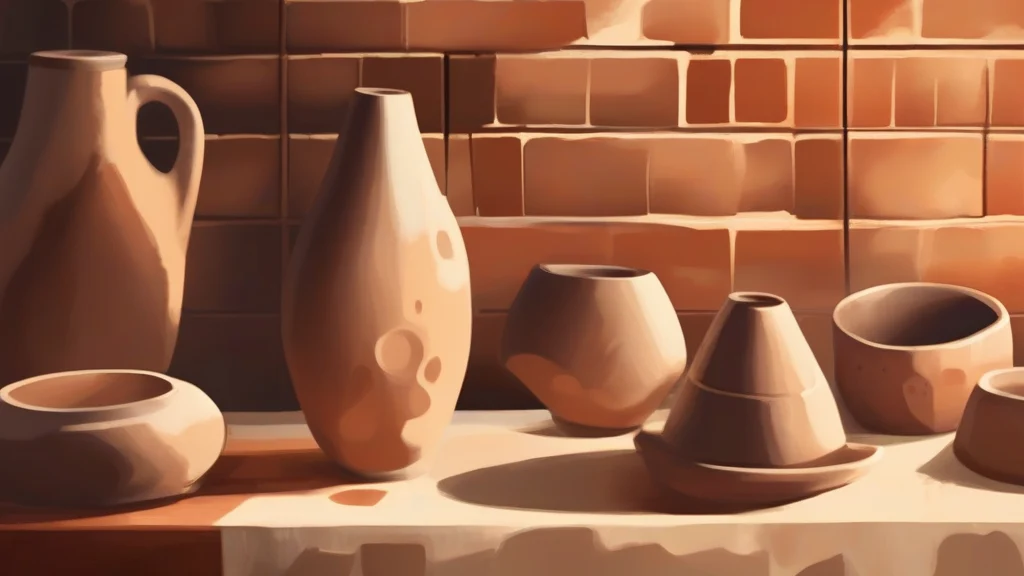
What does ceramic mean?
Ceramic describes any material or object formed from clay and then made hard, durable, and water-resistant by firing at high temperature. The word works both as an adjective, as in 'a ceramic vase' or 'ceramic floor tiles', and as a countable noun for an individual object so made. In its plural form, ceramics, it also names the art, craft, and industry of shaping and firing clay — a discipline stretching back thousands of years to some of humanity's earliest technologies. Ceramics range from humble earthenware pots and bricks to refined porcelain and advanced technical ceramics used in engineering and medicine. Because the term covers both everyday household items and high-art objects, its connotations shift with context: cozy and domestic in a kitchen, scholarly or artistic in a museum. It is a precise, useful alternative to vague terms like 'pottery' when discussing material properties.
Made of clay that has been shaped and then permanently hardened by firing at high temperature.
"He replaced the chipped plastic cups with sturdy ceramic mugs."
Almost always used attributively, directly before the noun it modifies.
An object, such as a pot, tile, or figurine, made from fired clay.
"The shelf was lined with small ceramics she had collected on her travels."
Often used in the plural; 'ceramics' may also denote the craft or study of making such objects.
As a plural noun, 'ceramics' refers either to multiple fired-clay objects or, as an uncountable singular-style subject, to the art and industry of making them.
"Her interest in ceramics began with a single evening pottery class."
The word traces back to the Greek 'keramos' — meaning potter's clay — and the ancient Athenian potters' quarter was named after it: the Kerameikos.
Reviewed by Deb Chak, Editor. AI-assisted content curated by RJS Tech Solutions LLP.
Etymology of ceramic
Ceramic derives from the Greek 'keramos', meaning potter's clay or earthenware, via the Latin 'ceramicus'. The word entered English around the mid-nineteenth century, when it became established as a technical term for fired-clay materials and the industry producing them. Its Greek root also survives in 'Kerameikos', the name of the famous potters' district of ancient Athens, underscoring how deeply the word is tied to the history of pottery itself.
Related word forms
How ceramic is actually used
In everyday speech 'ceramic' most often appears attributively before a noun (a ceramic mug, ceramic tiles). The plural noun 'ceramics' can mean either individual fired-clay objects or the craft/discipline itself; context usually makes clear which sense is meant.
Easily confused with ceramic
Porcelain is one specific type of fine, white, translucent ceramic ware, whereas ceramic is the broader term covering all heat-hardened clay products.