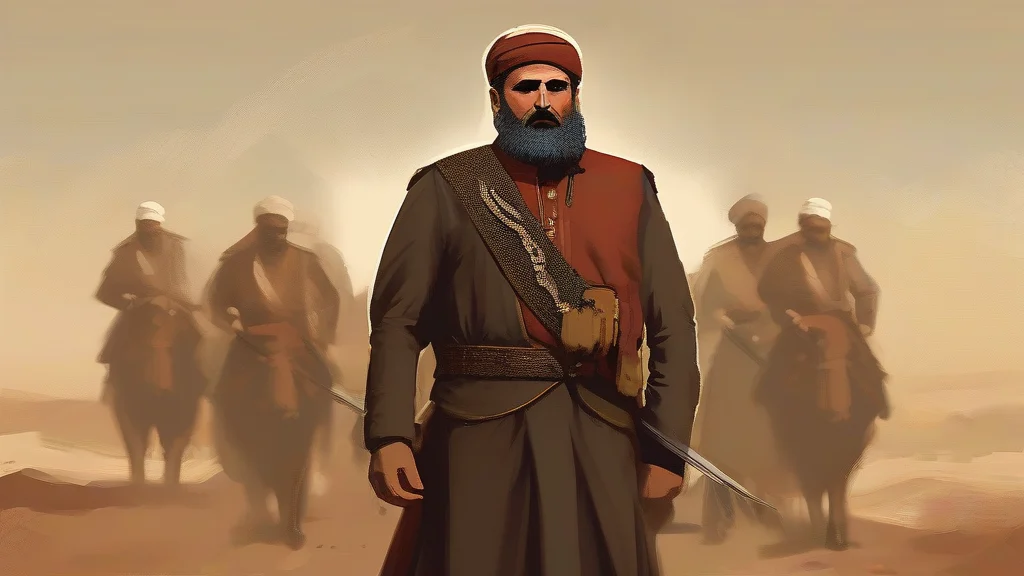
What does agha mean?
An agha was a figure of authority in the Ottoman Empire, the title being applied both to high-ranking military commanders and to civil officials or local notables. The commander of the Janissaries — the sultan's elite infantry — bore the title 'Agha of Aghas', making it one of the most powerful positions in the empire. Beyond the army, an agha might govern a district, own large estates, or act as the leading landholder of a village, arbitrating disputes and collecting dues. The word also functions as an honorific, appended after a man's name much like 'sir' or 'esquire' in European usage, and this polite sense persists in modern Turkish. English writers encounter the term mainly in histories of the Ottoman world and in travel literature from the Balkans, Anatolia, and the Middle East, where it evokes a world of provincial power, patronage, and inherited rank.
nounA title of respect or office for a commander, chief, or civil official in the Ottoman Empire and other parts of the former Turkish world; also used as an honorific placed after a man's name.
- A military commander or officer in the Ottoman Empire, especially one heading a corps such as the Janissaries.
- A civil official, governor, or local chieftain in Ottoman territories.
- An honorific title appended to a man's name in Turkey and parts of the former Ottoman world, roughly equivalent to 'sir' or 'master'.
"The agha of the Janissaries commanded the loyalty of the entire corps."
"The village agha settled disputes between farmers before they ever reached a distant court."
"In his dispatches, the ambassador referred to the commander simply as 'the Agha', as was customary at the Sublime Porte."
The standard English plural adds -s; the variant spelling 'agas' pluralizes identically.
"Several aghas attended the ceremony, each accompanied by his retinue."
The man in charge of the Ottoman sultan's elite Janissary corps wasn't called a general — he was the Agha of Aghas.
Reviewed by Deb Chak, Editor. AI-assisted content curated by RJS Tech Solutions LLP.
Etymology of agha
The word comes from Turkish 'ağa', meaning lord, master, or great man, a title adopted into many languages of the Ottoman sphere, including Arabic, Persian, and the Balkan tongues. It entered European usage through diplomatic and travel accounts of the Ottoman Empire, becoming familiar to English readers by the seventeenth century. Its ultimate origin lies in the Turkic languages of Central Asia, where related forms carried similar senses of elder or master.
How agha is actually used
The word belongs chiefly to historical writing about the Ottoman Empire, though it survives in modern Turkish as a polite form of address. It typically follows the name it qualifies ('Ali Agha') when used honorifically, but stands alone when denoting an office.
Easily confused with agha
"Aga" is simply a common variant spelling of the same Turkish title, while "Agas" (capital A) also refers to a brand of British range cooker.