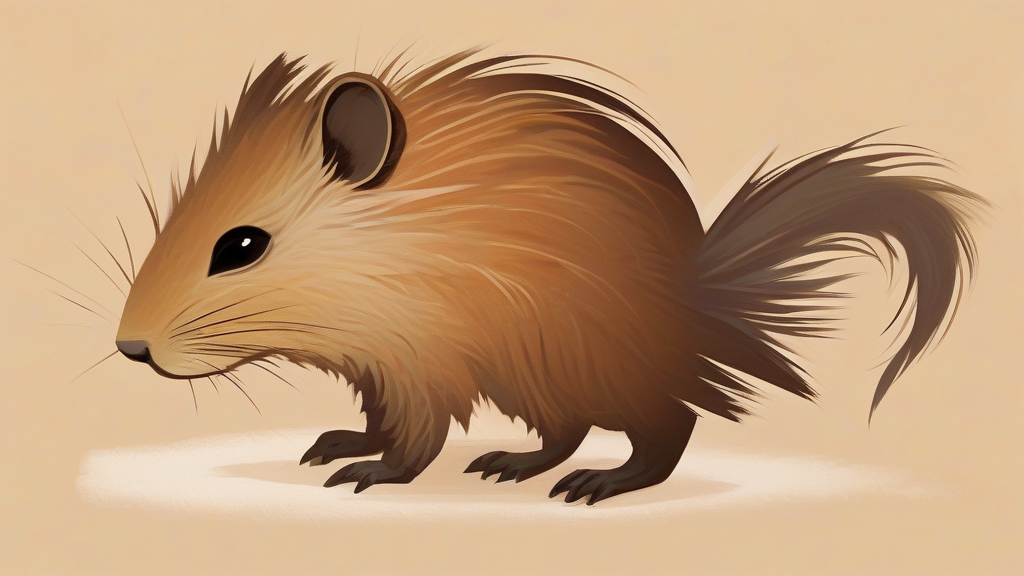
What does agouty mean?
Agouty is a variant spelling of agouti, the standard name for a rabbit-sized rodent of the genus Dasyprocta found in Central America, South America, and the Caribbean. Long-legged, swift-footed, and essentially tailless, the agouty feeds on fallen fruits and nuts and famously buries seeds, playing a vital role in regenerating tropical forests such as those around Brazil nut trees. In Caribbean islands like Trinidad and Barbados, it has long been hunted as bush meat and features in local folklore, including tales of the mischievous trickster figure Anansi's companion. Beyond the animal itself, the word also describes a distinctive kind of coat color: 'agouti' fur, in which each hair carries alternating bands of pigment, producing the grizzled look typical of wild rabbits, mice, and many domestic cats. Although 'agouty' survives in regional and historical usage, 'agouti' is the preferred modern spelling.
nounA variant spelling of 'agouti', denoting a rabbit-sized rodent of the genus Dasyprocta native to Central and South America and the Caribbean, noted for its long legs and its habit of sitting upright to eat. The term also refers to the grizzled banded pattern of animal fur in which each hair shows alternating light and dark rings.
- A rabbit-sized rodent of the genus Dasyprocta, native to Central America, South America, and the Caribbean, with long legs, a short tail, and a grizzled brown coat.
- The grizzled fur coloration in which each individual hair is banded with alternating light and dark rings, as seen in wild mice, rabbits, and many domestic breeds.
"An agouty darted across the forest floor, pausing to crack a fallen nut with its sharp incisors."
"Hunters tracked an agouty through the undergrowth near the plantation edge."
"The kitten's agouty coat shimmered with faint banding on every hair."
The plural follows standard English -ies formation for this spelling; note that the standard-spelling counterpart forms the plural 'agoutis'.
"Several agouties foraged along the riverbank at dusk."
Every tabby cat's coat owes its stripes to the same 'agouti' gene this word names — a rodent gave its name to one of genetics' most famous color patterns.
Reviewed by Deb Chak, Editor. AI-assisted content curated by RJS Tech Solutions LLP.
Etymology of agouty
The word derives from 'agouti', borrowed into European languages from indigenous Tupi–Guarani peoples of South America, whose word for the rodent was recorded by Portuguese and French naturalists in the early colonial period. It entered English in the seventeenth century through French and Spanish accounts of Brazilian wildlife. The spelling 'agouty' arose as an anglicized variant, particularly in West Indian usage, while the Tupi-derived root also gives us related South American rodent names such as acouchi.
How agouty is actually used
This spelling appears mainly in older texts and in Caribbean English; 'agouti' is now the standard form in dictionaries and scientific literature. When referring to the fur pattern rather than the animal, modern writers almost always use 'agouti'.
Easily confused with agouty
'Agouty' is simply a variant spelling of 'agouti', which is the standard form used in scientific and general English writing.
The guinea pig (Cavia porcellus) is a domesticated cavy rodent kept as a pet, whereas the agouty/agouti is a wild, longer-legged relative that lives free in American forests.