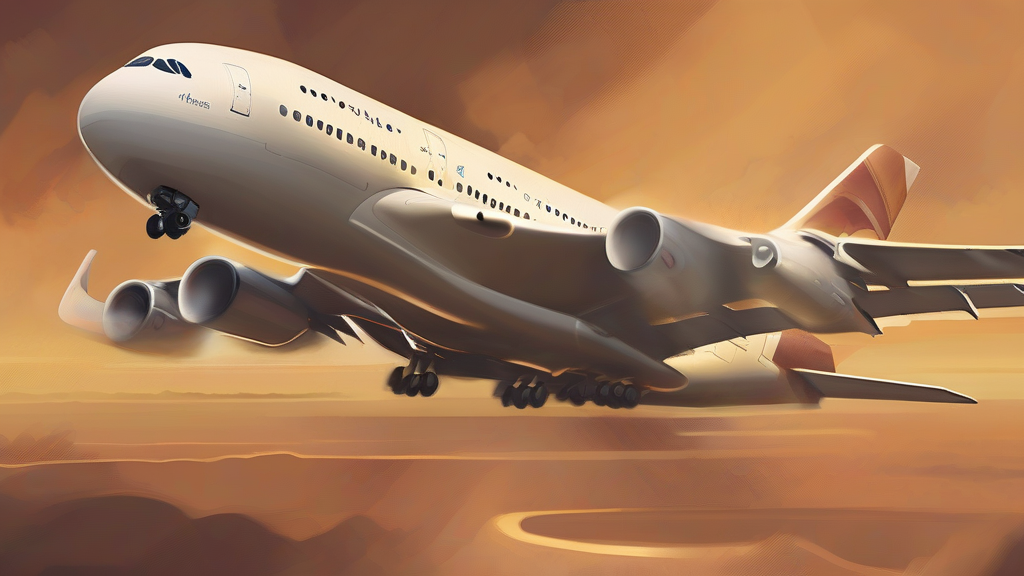
What does airbus mean?
An airbus is a large commercial passenger aircraft, most commonly understood to mean a wide-bodied jet airliner capable of carrying many passengers over long distances. The lowercase term predates and exists independently of the company: it arose as a generic nickname for roomy, high-capacity airliners, combining "air" with "bus," itself a shortened form of the Latin-derived "omnibus." The European manufacturer Airbus, formed by a consortium of European aerospace firms in 1970, so dominated this market segment that its name became nearly synonymous with the generic word. Today the two are closely linked but distinct: "Airbus" denotes the corporation and its specific aircraft models, while "airbus" in general usage describes any big passenger plane. The word appears mainly in travel, aviation, and journalistic contexts, and carries connotations of mass travel, modernity, and long-haul flight rather than small private aviation.
nounA large commercial passenger aircraft, especially a wide-bodied jet airliner. The term is also strongly associated with Airbus, the European aerospace manufacturer whose airliners popularized the name.
- Any large commercial passenger aircraft, particularly a wide-bodied jet airliner.
- An aircraft manufactured by Airbus, the European aerospace company.
"The airline replaced its aging fleet of narrow-body jets with new airbuses on its transatlantic routes."
"Passengers filed aboard the airbus for the overnight flight to Singapore."
"The airport's newest gate was built to accommodate the double-deck airbus."
The standard plural adds -es, following the pattern of "bus" → "buses."
"The carrier's hangars were filled with airbuses awaiting their next routes."
The word 'airbus' was flying as a generic nickname for big passenger planes years before the company that made it famous even existed.
Reviewed by Deb Chak, Editor. AI-assisted content curated by RJS Tech Solutions LLP.
Etymology of airbus
The word "airbus" combines "air" with "bus," the latter being a clipped form of "omnibus," a Latin word meaning "for all" that entered English in the early nineteenth century with horse-drawn public carriages. As a term for a large passenger aircraft, "airbus" emerged in mid-twentieth-century English as a colloquial label for high-capacity airliners. Its modern prominence owes much to Airbus, the European aircraft manufacturer established in 1970, whose success fixed the association between the generic word and the company's products.
How airbus is actually used
The capitalized form "Airbus" is a registered trademark of the aerospace manufacturer and should not be used generically. In everyday speech, travelers often use "airbus" loosely for any large airliner, though airlines and aviation professionals typically prefer precise model names such as A320 or A350.
Easily confused with airbus
"Airbus" (capitalized) refers specifically to the European aerospace corporation headquartered in Toulouse, while "airbus" in lowercase is a generic term for any large passenger aircraft.