
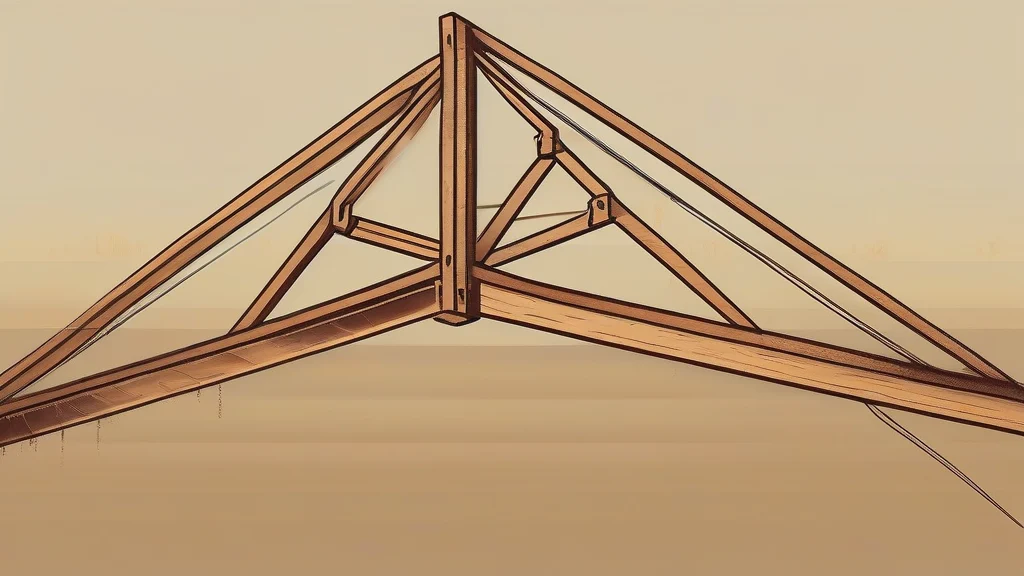
What does truss mean?
A truss is a rigid framework that supports loads, most commonly in a roof or bridge. Its members are arranged so that forces are carried through the structure rather than through a single solid beam. In construction, phrases such as “roof truss” and “truss bridge” refer to this supporting framework. The word can also describe a bundle or pack, especially of hay, reflecting its older association with something tied together. As a verb, to truss means to bind, fasten, brace, or support securely. It is chiefly a formal and technical term rather than everyday vocabulary, although “truss up” has a broader figurative use for making something firm or ready for action. The word is especially useful in discussing architecture and engineering because it names both the physical framework and the principle of organizing members into a stable, load-bearing structure.
A structural framework made of beams or other members that supports a roof, bridge, or similar load-bearing structure. In an older and less common sense, a truss is a bundle or pack, especially of hay.
"The carpenters installed a new truss across the ceiling."
The structural sense is dominant today and is common in engineering and construction. The bundle sense survives mainly in phrases such as “a truss of hay.”
To bind, fasten, brace, or support something securely.
"The builders trussed the roof before applying the final covering."
This use is formal and technical, though “truss up” can also have the broader meaning of making something firm or ready for action.
The standard plural of the noun is “trusses.”
"The old bridge was rebuilt with two steel trusses."
Before it described a bridge’s skeleton, a truss could mean a bundle—showing how the idea of things tied together became the idea of structures that bear loads.
Reviewed by Deb Chak, Editor. AI-assisted content curated by RJS Tech Solutions LLP.
Where does truss come from?
The word entered Middle English from Old French in the sense of a bundle or something tied together. Its Romance ancestry is commonly connected with Latin trusa, meaning “bundle,” and the same root appears in related forms such as trousse and trousseau. The structural meaning developed from the idea of separate members being tied together into a rigid framework capable of bearing loads.
Related word forms
How truss is actually used
The noun is primarily used in engineering, construction, and architecture. The verb is formal or technical and can mean to fasten or support securely; “truss up” is especially associated with securing a structure or making it rigid.
Easily confused with truss
A truss is a supporting framework or something fastened securely, whereas trust means confidence in someone or something or to rely on them.