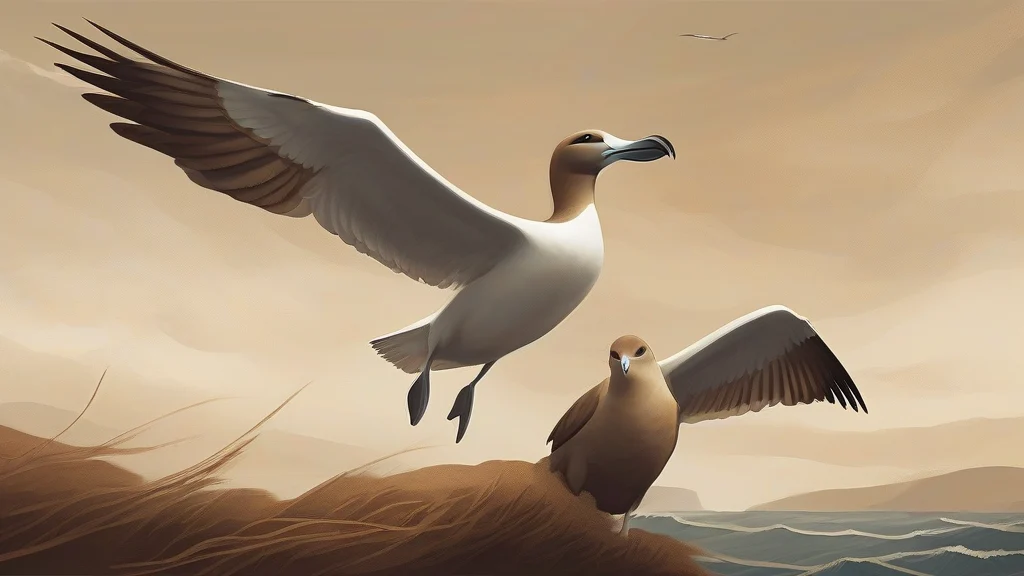
What does albatross mean?
The albatross is among the largest of flying birds, a magnificent ocean-going seabird with wingspans that can exceed three metres, found chiefly in the Southern Ocean and the North Pacific. Renowned for effortless gliding flight, albatrosses can travel enormous distances over open water with barely a wingbeat. Beyond ornithology, the word has taken on a powerful figurative meaning: an 'albatross' is any burdensome liability or source of persistent guilt that one cannot escape. This sense derives from Samuel Taylor Coleridge's poem 'The Rime of the Ancient Mariner' (1798), in which a sailor who kills an albatross must wear the dead bird around his neck as penance. Curiously, in golf the term means the opposite of a burden — an 'albatross' is an outstanding score of three under par on a single hole. Few words span such different registers, from natural history to moral metaphor to sporting triumph.
nounA very large oceanic seabird of the family Diomedeidae, noted for its long narrow wings and its ability to glide vast distances over the sea; figuratively, something that causes persistent worry or burden and is very hard to be rid of.
- A large long-winged oceanic seabird of the southern oceans and North Pacific.
- Figuratively, a source of persistent trouble, guilt, or encumbrance that is difficult to escape (from Coleridge's 'The Rime of the Ancient Mariner').
- In golf, a score of three strokes under par on a hole.
"The wandering albatross can glide for hours on the wind without flapping its wings."
"Sailors considered it bad luck to kill an albatross, believing the birds carried the souls of lost seamen."
"The failed acquisition became an albatross around the company's neck for years."
The standard plural is 'albatrosses'; occasionally 'albatross' is used as a plural form referring to the birds collectively.
"Colonies of albatrosses nest on remote sub-Antarctic islands."
In golf, an 'albatross' is a brilliant score — three under par on a single hole — yet in everyday life an albatross means exactly the opposite: a crushing burden you can't shake off.
Reviewed by Deb Chak, Editor. AI-assisted content curated by RJS Tech Solutions LLP.
Etymology of albatross
The word 'albatross' entered English in the late 17th to early 18th century, adapted from the older form 'alcatras', which came via Portuguese 'alcatraz' — a name Portuguese sailors applied to various large seabirds, including frigatebirds and pelicans. The Portuguese term itself is often traced to Arabic origins. When English sailors encountered the great southern seabirds, the existing name was transferred to them, gradually settling into the modern spelling 'albatross'. A related form survives in the name of the island prison 'Alcatraz' in San Francisco Bay.
How albatross is actually used
The figurative sense carries strongly negative connotations of guilt or inescapable burden, popularized by Samuel Taylor Coleridge's 1798 poem 'The Rime of the Ancient Mariner', in which a mariner is forced to wear a dead albatross around his neck as punishment. The golfing sense, by contrast, is positive and celebratory. The plural is typically 'albatrosses', though 'albatross' is sometimes used as a collective plural.
Easily confused with albatross
An albatross is a large seabird, while an albacore is a species of tuna fish; the two names look similar but refer to entirely different animals.