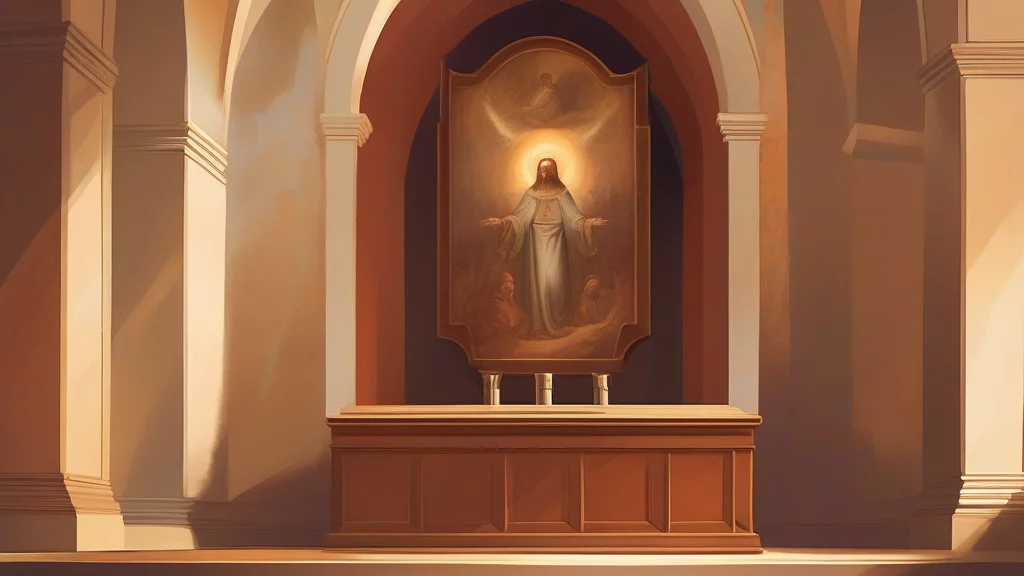
What does altarpiece mean?
An altarpiece is a work of art — usually a painted panel, a sculpted relief, or a combination of both — positioned on or behind the altar of a Christian church, where it serves as the visual focal point of worship. Ranging from modest single panels to vast multi-part polyptychs, altarpieces flourished especially between the fourteenth and sixteenth centuries, when artists such as Duccio, van Eyck, and Grünewald produced some of the most celebrated works in European art. The word carries strong associations with religious devotion, craftsmanship, and the history of painting and sculpture, and it appears most often in art-historical, museum, and travel writing. Closely related terms include retable and reredos, which describe similar altar furnishings; the distinctions among them can be subtle. For anyone studying Western art or visiting historic churches, 'altarpiece' is an essential term for describing one of the genre's central art forms.
nounA work of art, typically a painting, sculpture, or carved panel, placed on or behind the altar of a Christian church.
- A painting or sculpture set on or behind a Christian church altar as the focus of devotion.
- More broadly, any decorated panel or structure adorning the altar area of a church.
"The cathedral's sixteenth-century altarpiece dominates the east end of the nave."
"Duccio's Maestà once served as the high altarpiece of Siena Cathedral."
"Conservators spent years cleaning the smoke-darkened surface of the wooden altarpiece."
Standard plural form; used when referring to multiple works, e.g. across different churches or periods.
"The exhibition brought together altarpieces from across fifteenth-century Flanders."
The Ghent Altarpiece — stolen, dismembered, and hidden so many times it's been called the most stolen artwork of all time.
Reviewed by Deb Chak, Editor. AI-assisted content curated by RJS Tech Solutions LLP.
Etymology of altarpiece
The word 'altarpiece' derives from 'altar', which comes from Latin 'altare', meaning a raised structure for sacrifice, combined with the English noun 'piece'. It emerged in English usage around the early seventeenth century as interest in church furnishings and continental religious art grew. Related terms such as 'retable' (from French) and 'reredos' (from Old French, ultimately from Latin 'retro' meaning 'behind') describe comparable structures and reflect the same ecclesiastical vocabulary tradition.
How altarpiece is actually used
The term belongs chiefly to art history and ecclesiastical contexts and is neutral in register. In Spanish-speaking traditions the related word 'retablo' is often used for the same kind of object.
Easily confused with altarpiece
A reredos is an ornamental screen or structure behind the altar, often architectural rather than a single artwork, whereas an altarpiece is the artwork itself.