What does fleece mean?
Fleece has two main lives in modern English. Its oldest sense is agricultural: the fleece is the woolly coat of a sheep, particularly when it is shorn off in a single piece, a word that reaches back to the earliest layers of the English language and echoes through myth in the Golden Fleece sought by Jason and the Argonauts. Its newer sense is textile: fleece is a soft, deep-piled fabric — most familiar as 'polar fleece' — prized for being lightweight, breathable, and warm even when damp, and widely used for jackets, blankets, and outdoor clothing. In Britain especially, 'a fleece' often means such a garment itself. As a verb, to fleece someone is to swindle them or charge exorbitantly, a figurative extension that treats the victim as a sheep to be shorn; the adjective form is 'fleecy', describing something soft and wool-like. Few everyday words connect farmyard, fabric shop, and confidence trick so neatly.
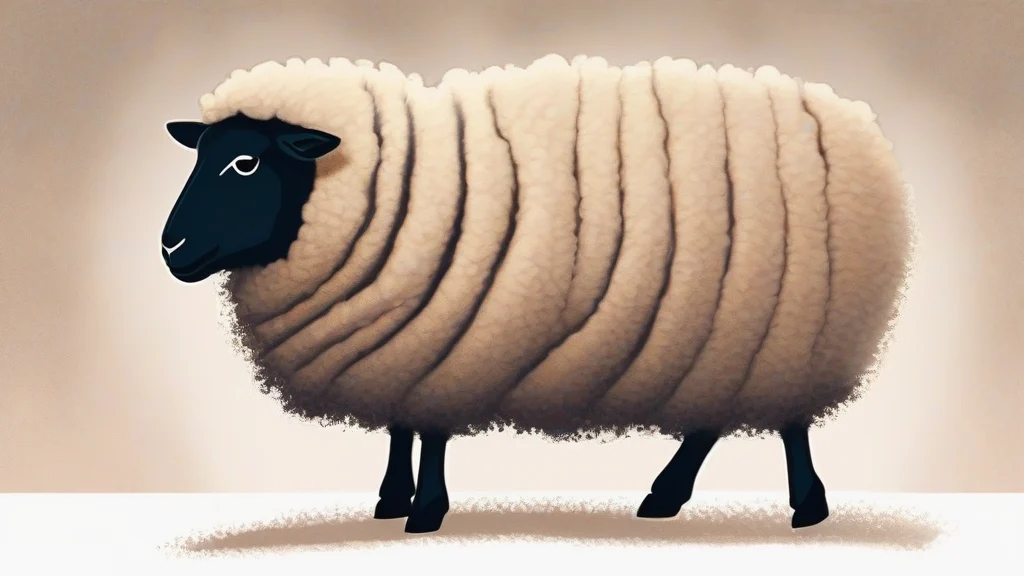
The woolly coat of a sheep, especially when shorn off in one piece; also a soft warm fabric imitating this, or a garment made from it.
"The prize ram produced the finest fleece at the county show."
Countable when referring to a single shorn coat; often uncountable for the wool or fabric. In British usage, 'a fleece' frequently means a fleece jacket.
To swindle or extract an excessive amount of money from someone; also, to shear the fleece from a sheep.
"Tourists complained that the taxi drivers had fleeced them on the airport run."
The figurative swindling sense dominates modern usage; the literal shearing sense is now mainly found in farming contexts.
The plural applies to individual shorn coats of wool, to fleece garments, or to instances of swindling; the material or fabric itself is usually treated as uncountable.
"The wool merchant graded the fleeces before auction."
Jason sailed across the ancient world chasing a Golden Fleece — today the same word labels the $15 polyester jacket at every campsite.
Reviewed by Deb Chak, Editor. AI-assisted content curated by RJS Tech Solutions LLP.
Etymology of fleece
Fleece comes from Old English 'flēos', meaning the wool of a sheep, tracing back through Proto-Germanic '*flūsaz'. It has direct continental cognates in Dutch 'vlies' and German 'Vlies' — the latter famous from 'das Goldene Vlies', the Golden Fleece of Greek legend. Some scholars suggest the Old English word may have been influenced in form by Latin 'vellus', another word for a sheep's fleece, though the core lineage is firmly Germanic. The word has been in continuous English use for over a thousand years, with the swindling verb sense developing later as a figurative extension of shearing.
Related word forms
How fleece is actually used
As a noun, 'fleece' is uncountable when referring to the wool itself but countable for an individual shorn coat ('a fleece'). In British English, 'a fleece' very commonly means a fleece-lined casual jacket. As a verb, 'fleece' carries strongly negative connotations of exploitation or fraud and is informal to mildly formal in tone; the passive participle 'fleeced' is a common way of complaining about being overcharged.
Easily confused with fleece
'Flees' is the verb meaning runs away (third person singular of 'flee'), while 'fleece' refers to a sheep's wool or the act of cheating someone.