
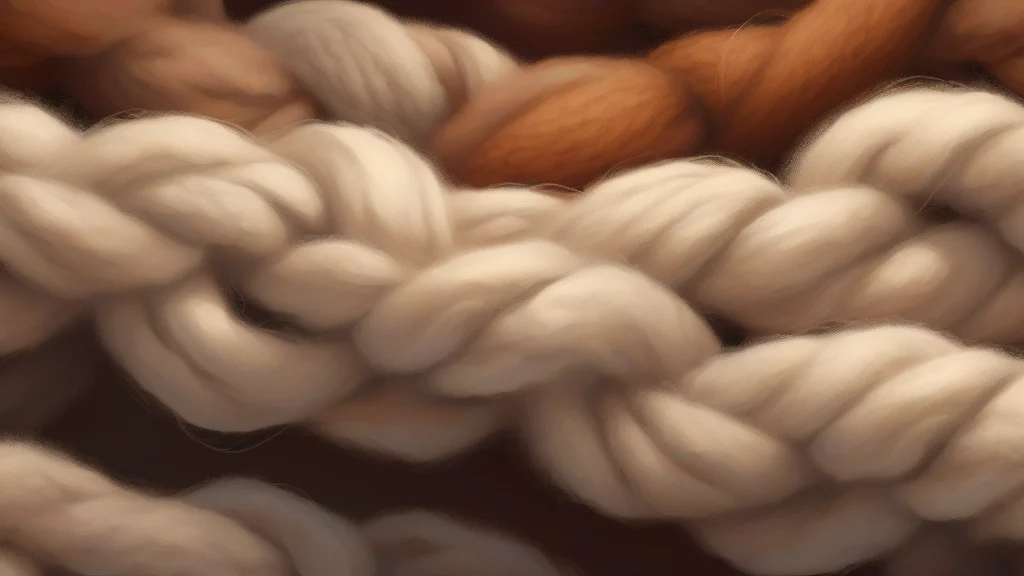
What does wool mean?
In ordinary English, wool is the soft, fine fiber obtained from a sheep’s fleece and used to make yarn, fabric, and clothing. It can also refer more broadly to textiles made from that fiber, as in “a wool coat.” Wool is valued for being warm, durable, breathable, and naturally resistant to odors and moisture, which gives it associations with traditional craftsmanship, rural life, and winter clothing. The word is usually treated as a mass noun: speakers say “pure wool,” “a ball of wool,” or “a wool sweater,” but rarely “a wool” in the material sense. Although sheep are the best-known source, wool can also come from goats, alpacas, camels, and other animals. In British and some other regional varieties, “wool” also exists as a rare verb meaning to shear or collect wool from a sheep. Its long history and close connection with textile production make it a useful example of a word that names both a raw material and the fabric made from it.
The soft, fine hair or fiber obtained from sheep and, less commonly, other mammals, especially when spun into yarn or woven into fabric; also fabric made from this material.
"The blanket is made from warm, durable wool."
Normally an uncountable mass noun. In phrases such as “wool trousers,” it functions attributively and means made of wool.
To shear or collect wool from a sheep.
"The farmer wooled the sheep before the summer heat."
Rare and chiefly regional, especially in British English.
The plural is uncommon because wool is normally a mass noun; “wools” can refer to distinct kinds or qualities of wool.
"The catalogue lists wools from several different breeds of sheep."
Wool is warmth with a memory: spun from sheep’s fleece and woven into textiles for thousands of years.
Reviewed by Deb Chak, Editor. AI-assisted content curated by RJS Tech Solutions LLP.
Where does wool come from?
The English word descends from Old English wull, which referred to the hair or fleece of sheep and the fiber obtained from it. It belongs to a Germanic word family that also includes Dutch wol, German Wolle, Swedish ull, and Danish uld. The word developed alongside the long history of wool production and textile manufacture in Europe, with its modern form reflecting the regular development of the Old English vowel.
Related word forms
How wool is actually used
Wool is normally an uncountable mass noun, so one says “a piece of wool” or “a wool sweater” rather than “a wool.” The verb “wool” is uncommon and chiefly regional in British English; “woolen” and “woollen” are the standard adjective forms in American and British English respectively.
Easily confused with wool
“Whole” means complete or entire, while “wool” is the fibrous material obtained from sheep or fabric made from it.