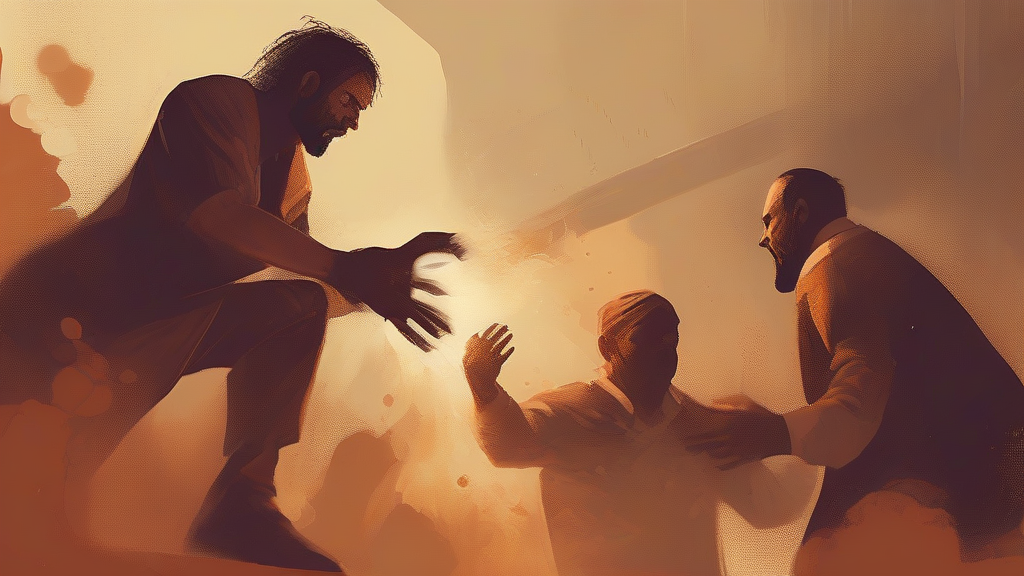
What does altercation mean?
An altercation is a noisy, heated argument or dispute, usually between two or more people and often in a public setting. The word suggests raised voices, sharp exchanges, and visible friction — more intense than a simple disagreement, though not necessarily involving physical contact; when violence does occur, speakers commonly say 'physical altercation.' Altercation belongs chiefly to formal and journalistic registers: police reports, court records, and news articles frequently describe incidents as altercations rather than mere arguments, lending the word an air of official detachment. It derives from the Latin verb altercari, meaning to dispute, built on alter, 'the other of two' — fittingly, a word about conflict rooted in the idea of two opposing sides. For writers, it offers a precise, slightly elevated way to characterize a quarrel without resorting to slang or understatement.
nounA noisy argument or heated dispute, typically one conducted in public or in raised voices.
- A noisy or heated argument or dispute, especially one between people in public.
"The two drivers became locked in a heated altercation at the intersection."
"Security cameras captured the altercation that broke out outside the stadium after the match."
"What began as a mild disagreement over seating quickly escalated into an altercation."
The plural is standard and commonly used when referring to repeated disputes or multiple incidents.
"The tenant's file documented several altercations with neighboring residents."
Despite sounding like it might mean 'a change of heart,' an altercation has always meant the opposite — a clash — because it comes straight from the Latin word for 'other.'
Reviewed by Deb Chak, Editor. AI-assisted content curated by RJS Tech Solutions LLP.
Etymology of altercation
Altercation comes from the Latin verb altercari, meaning 'to dispute' or 'to bandy words,' which itself derives from alter, meaning 'other' or 'another of two.' The word entered English in the late Middle Ages via Old French, with written use attested from around the fourteenth century. It shares its Latin root with related English words such as alternate, alternative, and alteration, all built on the notion of 'the other.'
How altercation is actually used
Altercation carries a somewhat formal register and often appears in news reports and legal contexts. It implies more heat and noise than a mere disagreement but stops short of implying physical violence, though the phrase 'physical altercation' is common when blows are exchanged.
Easily confused with altercation
An alteration is a change or modification to something, whereas an altercation is a noisy argument or quarrel.