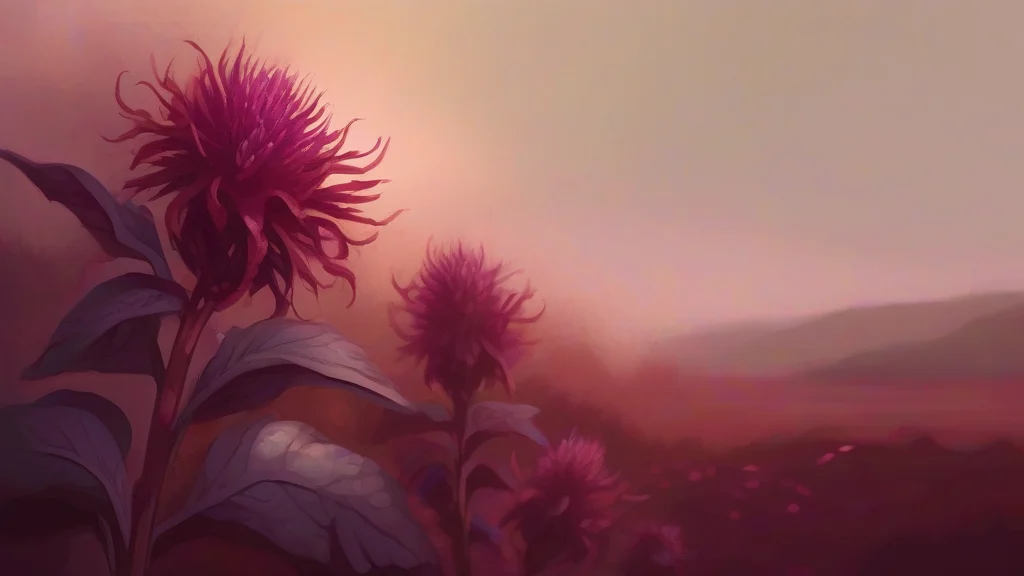
What does amaranthine mean?
Amaranthine is an adjective with two closely linked meanings: it describes something everlasting or undying, and it denotes a deep purplish-red colour associated with the amaranth flower. The word derives from the Greek name for the amaranth, a plant whose blooms were famed for retaining their colour long after being cut, making it an ancient symbol of immortality. Writers have long reached for 'amaranthine' when they want to evoke eternal beauty — an undying love, a fame that will not fade, or a paradise where flowers never wither. In modern usage it appears just as often in purely visual contexts, describing fabrics, dyes, cosmetics, and sunsets in that rich reddish-purple shade. Because of its poetic pedigree, the word carries a formal, elevated register and lends any sentence a touch of romance. Readers meet it in literature, art criticism, and descriptive journalism, where its double meaning — unfading in time, vivid in colour — makes it unusually versatile for a single term.
adjectiveOf a deep purplish-red colour like that of the amaranth flower; more broadly, undying, everlasting, or eternally beautiful.
- Undying, everlasting, or eternally beautiful (the original and figurative sense).
- Of a deep purplish-red colour resembling that of the amaranth flower.
"The sunset painted the sky in amaranthine hues that seemed to glow long after dark."
"Legends spoke of an amaranthine rose that would never wilt, however harsh the winter."
"She wore a gown of amaranthine silk that drew every eye in the room."
Milton gave the amaranth a starring role in Paradise Lost as the flower said to bloom in heaven — which is why 'amaranthine' still means both immortal and a rich purple-red.
Reviewed by Deb Chak, Editor. AI-assisted content curated by RJS Tech Solutions LLP.
Etymology of amaranthine
Amaranthine comes from the Greek 'amarantos', meaning 'unfading' or 'undying', applied to the amaranth plant whose flowers famously kept their colour after drying. The word entered English through Latin and later French forms in reference to the plant itself, and by the early seventeenth century writers were using 'amaranthine' figuratively to mean immortal or everlasting. Its closest English relatives are the noun 'amaranth' (and its variant form 'amarant'), which share the same Greek root.
How amaranthine is actually used
Amaranthine is a literary, formal word, most often encountered in poetry, descriptive prose, and writing about art or fashion. Its figurative sense (undying) carries a lofty, romantic connotation, while its colour sense is now the more frequent use in everyday contexts such as describing fabrics, dyes, and sunsets.
Easily confused with amaranthine
Amaranth is the noun naming the plant or its colour, while amaranthine is the adjective describing something that resembles it in colour or in never-fading quality.