What does amazonite mean?
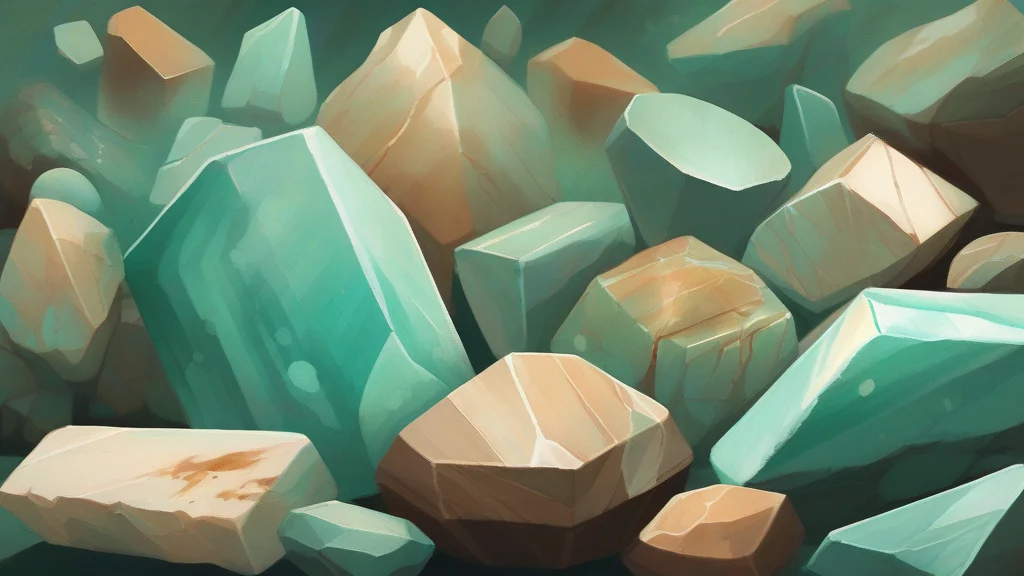
Amazonite is a translucent to opaque green variety of microcline, a potassium-rich feldspar, prized as a semi-precious gemstone. Its colour ranges from soft blue-green to deep turquoise-green, often streaked with white lines caused by its crystalline structure. The stone takes its name from the Amazon River, although no significant deposits have ever been found there; notable sources today include Colorado in the United States, Brazil, Madagascar, and Russia. Because it polishes well, amazonite has long been favoured for beads, pendants, cabochons, and small carvings — ancient Egyptian artisans famously worked it into scarabs and amulets. In modern usage the word appears chiefly in gemmology, mineralogy, and jewellery retail, where it denotes both the mineral itself and finished pieces made from it. Its gentle green hue has also given it a place in decorative design and in traditions that attribute calming properties to coloured stones.
nounA green variety of the mineral microcline (potassium feldspar), often used as a decorative gemstone.
- A green variety of microcline feldspar used as a semi-precious gemstone and ornamental material.
"She wore a silver pendant set with a polished piece of amazonite."
"The jeweller set the ring with a cabochon of pale blue-green amazonite."
"Ancient Egyptians carved amazonite into scarabs and amulets more than three thousand years ago."
The plural is uncommon because mineral names usually function as mass nouns; it appears mainly in trade contexts referring to multiple cut stones.
"The stall displayed dozens of polished amazonites from Madagascar."
Amazonite was named after the Amazon River, even though it has never actually been mined there — early collectors simply mistook other green stones found along its banks for it.
Reviewed by Deb Chak, Editor. AI-assisted content curated by RJS Tech Solutions LLP.
Etymology of amazonite
The word amazonite derives from the name of the Amazon River, which in turn comes from Greek Amazōn, referring to the mythical warrior women. Early European collectors associated green stones found near the river with the locality, giving rise to the mineral's name, even though amazonite itself does not occur there. It entered English scientific usage by the nineteenth century as mineralogical naming conventions became standardised.
How amazonite is actually used
Used mainly in geology, gemmology, and jewellery contexts; the term is technical rather than everyday vocabulary. The word is invariable as a mineral name and appears most often in trade and lapidary writing.
Easily confused with amazonite
The Amazon is a South American river (and, in mythology, a race of warrior women); amazonite is a green mineral named after the river.
Amethyst is a purple variety of quartz, whereas amazonite is an opaque green feldspar.