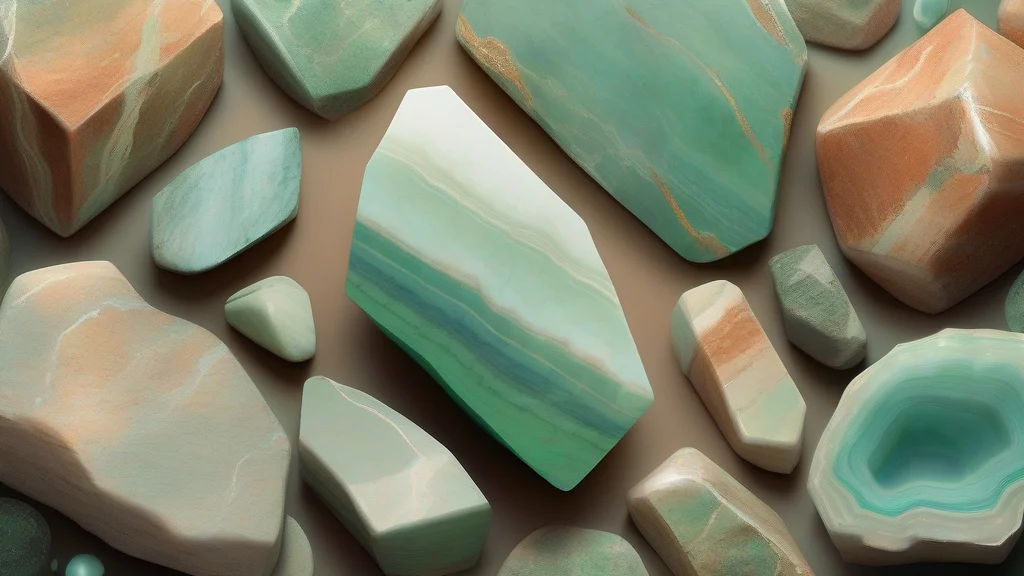
What does amazonstone mean?
Amazonstone is a bright green variety of microcline, a potassium feldspar mineral, prized for its distinctive turquoise-to-green color and opaque, slightly veined appearance. It is better known today by its alternative name, amazonite, which is the term preferred by mineralogists and the gem trade; 'amazonstone' survives chiefly in older literature and among collectors of antique jewelry and lapidary work. The stone has been used for ornaments, beads, and carved objects since antiquity — notably by ancient Egyptians — and significant deposits occur in places such as Colorado, Russia, and Brazil. The name derives from the Amazon River, though the stone was never actually sourced there, a misnomer that arose when early European explorers mistook other green stones traded in the region for this feldspar. For readers encountering the word, it signals a historical or specialist context rather than everyday usage.
nounA bright green variety of the mineral microcline feldspar, more commonly known as amazonite, used as a decorative and gemstone material.
- A bright green variety of microcline feldspar, used ornamentally and as a gemstone; also called amazonite.
"The pendant was carved from a polished piece of amazonstone, its green surface veined with delicate white streaks."
"The museum's mineral collection included a striking slab of amazonstone from Colorado."
"Ancient Egyptian craftsmen carved amulets from amazonstone, treasuring its vivid turquoise-green hue."
The plural is rare, appearing mainly when referring to multiple specimens in a collection or lot.
"The dealer displayed several amazonstones alongside quartz and jasper specimens."
Despite its name, amazonstone was never found near the Amazon River — early explorers apparently confused it with other green stones traded there.
Reviewed by Deb Chak, Editor. AI-assisted content curated by RJS Tech Solutions LLP.
Etymology of amazonstone
The word 'amazonstone' takes its name from the Amazon River, reflecting the belief of early European traders and explorers that the green stone came from that region — a belief later shown to be mistaken, since no deposits exist there. The mineral itself is a variety of microcline feldspar, and the shorter modern name 'amazonite' shares the same origin. The ultimate source is Greek mythology's Amazons, the legendary warrior women associated with the river's naming.
How amazonstone is actually used
Amazonstone is a somewhat dated term; modern mineralogists and gem dealers almost always use 'amazonite' instead. It appears mainly in older texts, lapidary contexts, and antique descriptions.
Easily confused with amazonstone
Amazonite is the standard modern mineralogical name for the same green feldspar, while 'amazonstone' is an older, largely historical synonym.
Jade is a different green gemstone (nephrite or jadeite) that amazonstone can resemble in color but differs from in hardness, composition, and value.