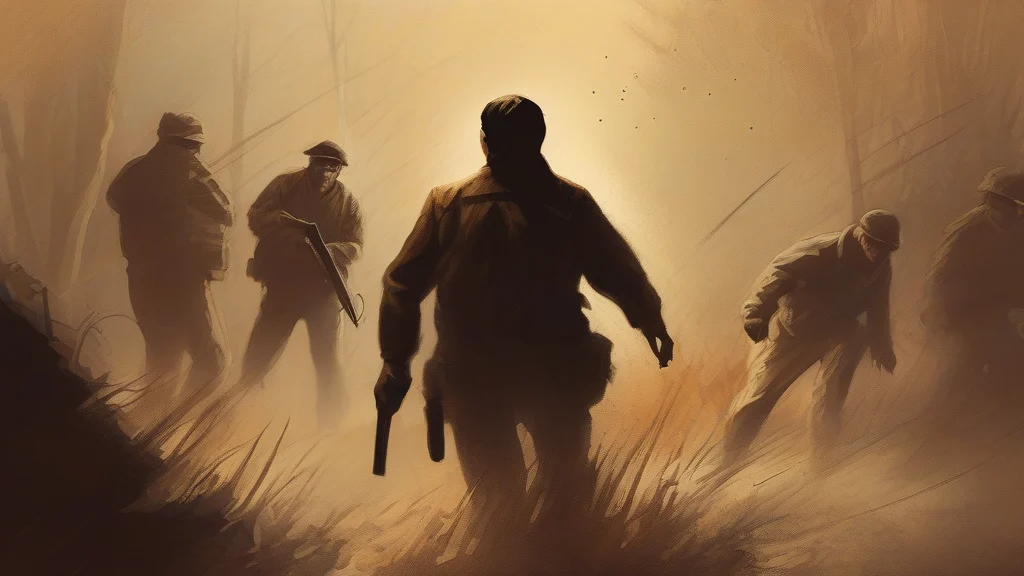
What does ambushed mean?
Ambushed is the past tense and past participle of the verb ambush, meaning to attack or waylay someone by surprise from a hidden position. In its primary sense it describes a sudden, concealed assault — soldiers ambushed in a valley, travellers ambushed on a road — and it carries strong connotations of treachery, vulnerability, and helplessness on the part of the victim. Beyond warfare, the word is widely used figuratively: a politician may be ambushed by hostile questions, a writer ambushed by an unexpected emotion, or a commuter ambushed by a downpour. This figurative flexibility makes it a vivid choice whenever someone is caught off guard through no fault of their own. The word derives ultimately from Old French embusche ('hiding in bushes'), which entered English in the sixteenth century alongside developments in military tactics. Whether literal or metaphorical, being ambushed implies an attacker who planned in advance and a target who never saw it coming — a dynamic that gives the word its enduring dramatic power in news reporting, fiction, and everyday speech alike.
Past tense and past participle of ambush: attacked someone by surprise from a concealed position.
"Guerrillas ambushed the supply column on the mountain road."
Describing something that has been subjected to an ambush (used attributively with nouns such as 'an ambushed patrol').
"Rescuers reached the ambushed convoy hours after the attack."
This participial adjective use is less common than the verbal use but appears regularly in news writing.
The word 'ambush' hides inside French 'embusche' — meaning to hide in a bush — so every ambush literally carries a shrub in its family tree.
Reviewed by Deb Chak, Editor. AI-assisted content curated by RJS Tech Solutions LLP.
Etymology of ambushed
Ambushed comes from ambush, which entered English in the mid-sixteenth century from the Old French embusche, meaning 'to hide in the bushes' — itself derived from a Frankish root related to hiding in woods. The word arrived during a period when English was absorbing many French military terms, and it has retained both its tactical meaning and its figurative use ever since. Cognates include the French embuscade and related Romance forms built on the same Germanic root.
Related word forms
How ambushed is actually used
Ambushed is almost always used passively — people are ambushed rather than ambush — though active uses ('they ambushed the convoy') are common in journalism and military writing. Figurative uses (ambushed by deadlines, ambushed by grief) are well established in informal writing.
Easily confused with ambushed
Ambush is the base noun and verb form, while ambushed is its past-tense and past-participle form describing an attack that has already happened.