What does amphitheater mean?
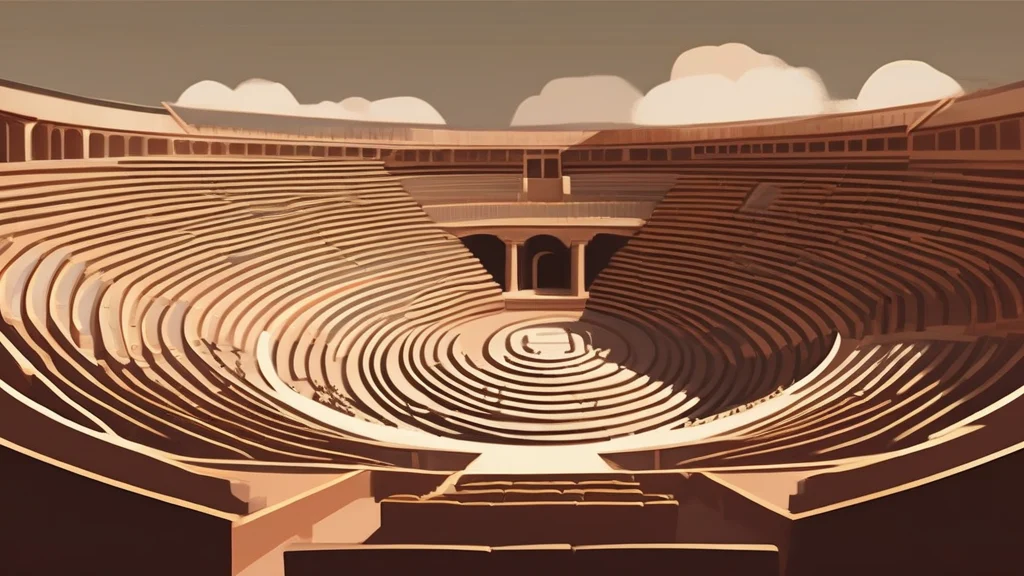
An amphitheater is an oval or circular open-air structure with tiers of seats rising around a central arena, designed so that spectators can view an event from every side. The form was perfected by the Romans, who built monumental stone examples such as the Colosseum to host gladiatorial combats, animal hunts, and public executions. The name derives from Greek roots meaning 'around on both sides', reflecting the seating that encircled the arena completely — a departure from the semicircular Greek theater. Today the term describes both these ancient ruins, which survive across Europe, North Africa, and the Middle East, and modern outdoor venues such as hillside concert bowls and park bandshells that echo the same design. The word evokes antiquity, spectacle, and communal gathering, and it appears frequently in historical, archaeological, and travel writing. American spelling favors 'amphitheater', while British usage prefers 'amphitheatre'.
nounAn oval or circular open-air venue with tiered seating rising around a central arena or stage, used in antiquity for gladiatorial contests and public spectacles, and today for performances and events.
- A classical oval or circular open-air structure with tiers of seats surrounding a central arena, used especially by the Romans for gladiatorial games and spectacles.
- Any modern outdoor venue with raked or tiered seating arranged around a stage or performance area.
"The Roman amphitheater at Arles still hosts bullfights each summer."
"Gladiators once fought before roaring crowds in the great amphitheaters of the Roman Empire."
"We spread our blanket on the grassy slope of the hillside amphitheater as the orchestra tuned up below."
The standard plural adds -s; British spelling yields 'amphitheatres'.
"The tour visited three remarkably preserved Roman amphitheaters along the Mediterranean coast."
The word literally means 'on both sides' — the Greeks coined it because spectators sat all the way around, unlike their half-circle theaters.
Reviewed by Deb Chak, Editor. AI-assisted content curated by RJS Tech Solutions LLP.
Etymology of amphitheater
The word 'amphitheater' comes from Latin 'amphitheatrum', itself borrowed from Greek 'amphitheatron', formed from 'amphi-' (meaning 'around, on both sides') combined with 'theatron' ('a place for viewing'). The Greek compound described the fully encircling seating arrangement that distinguished Roman arenas from the half-round Greek theater. The term entered English in the early seventeenth century through Latin learning. Cognates sharing the 'amphi-' root include 'amphibian' and 'amphora'.
How amphitheater is actually used
The spelling 'amphitheater' is standard in American English; British English typically uses 'amphitheatre'. The word carries connotations of antiquity and spectacle, though it applies equally to modern concert venues. It is a neutral, largely formal register word common in historical writing, tourism, and event contexts.
Easily confused with amphitheater
A theater is typically a semicircular building with seating facing a stage, whereas an amphitheater has seating on all sides surrounding a central arena.
Amphitheatre is simply the British spelling of the same word, not a different term.