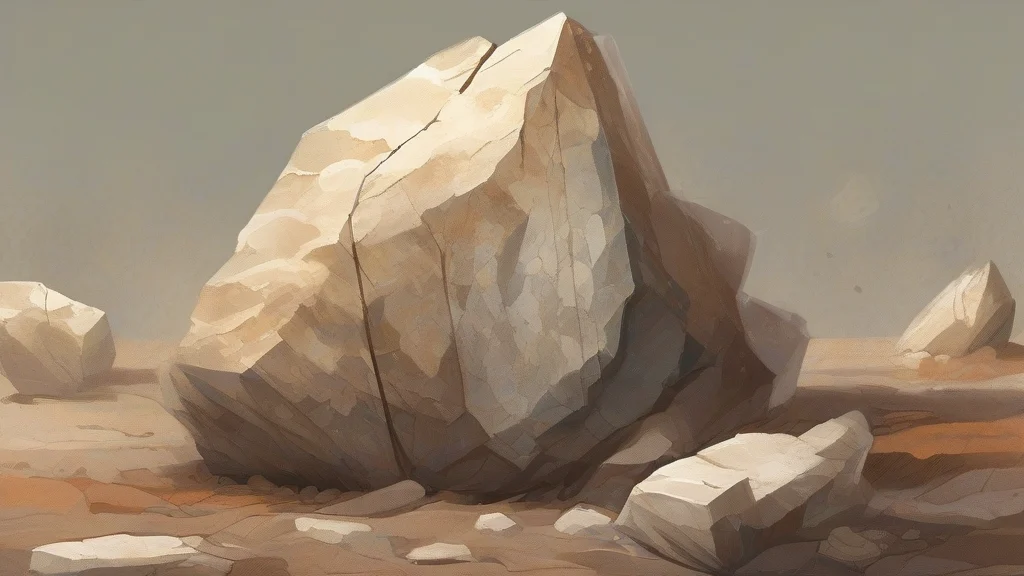
What does anorthosite mean?
Anorthosite is a coarse-grained igneous rock composed overwhelmingly of plagioclase feldspar—most commonly the calcium- and sodium-rich varieties labradorite and anorthite—with only minor amounts of other minerals such as pyroxene, olivine, or ilmenite. On Earth it occurs most famously as enormous Precambrian intrusions in regions like the Adirondack Mountains of New York, southern Greenland, and parts of Scandinavia and Quebec, where it has occasionally been quarried as dimension stone. Anorthosite also plays a starring role in planetary science: the pale, rugged lunar highlands are largely made of anorthosite, which formed as buoyant plagioclase crystals floated to the top of a primordial magma ocean on the young Moon. The word is strictly technical, appearing in geology textbooks, research papers, and mission reports rather than everyday conversation, yet it offers a vivid link between deep terrestrial history and the origins of the Moon itself.
nounA coarse-grained, light-coloured igneous rock composed almost entirely of plagioclase feldspar (chiefly labradorite and anorthite), typically found in the ancient cores of continents and in the lunar highlands.
- A coarse-grained igneous rock consisting predominantly (typically over 90%) of plagioclase feldspar, especially labradorite or anorthite.
"The lunar highlands gleam white because they are largely covered by anorthosite."
"The Adirondack Mountains contain vast bodies of Precambrian anorthosite that were once quarried for building stone."
"Analysis of lunar samples showed the Moon's bright highland crust is dominated by anorthosite, evidence of an early global magma ocean."
As a rock type, anorthosite is usually treated as a mass noun and left uninflected; the plural appears mainly when referring to distinct occurrences, bodies, or samples of the rock.
"Proterozoic massif-type anorthosites occur across Canada, Scandinavia, and India."
Chunks of anorthosite brought back from the Moon by Apollo astronauts helped scientists prove the Moon once had a globe-spanning ocean of molten rock.
Reviewed by Deb Chak, Editor. AI-assisted content curated by RJS Tech Solutions LLP.
Etymology of anorthosite
Anorthosite derives from 'anorthite', the name of a calcium-rich plagioclase feldspar identified from a specimen found at Monte Somma near Vesuvius, Italy, and named in the early nineteenth century. The mineral name combines Greek roots: 'a-' meaning 'not' and 'orthos' meaning 'straight' or 'right', because anorthite's crystal faces deviate obliquely from those expected of a right-angled form — hence literally 'not straight'. The rock name anorthosite simply attaches the standard '-ite' rock-suffix convention to this dominant constituent mineral. Cognate terms sharing the same Greek root include the crystallographic adjective 'anorthic'.
How anorthosite is actually used
Anorthosite is a technical term used mainly in geology, planetary science, and mining; it is rarely encountered outside these fields. It carries no figurative or colloquial use. Geologists distinguish terrestrial varieties such as Proterozoic massif-type anorthosite from the lunar anorthosite of the Moon's highland crust.
Easily confused with anorthosite
Andesite is a fine-grained volcanic rock of intermediate composition, whereas anorthosite is a coarse-grained intrusive rock made almost entirely of plagioclase feldspar.