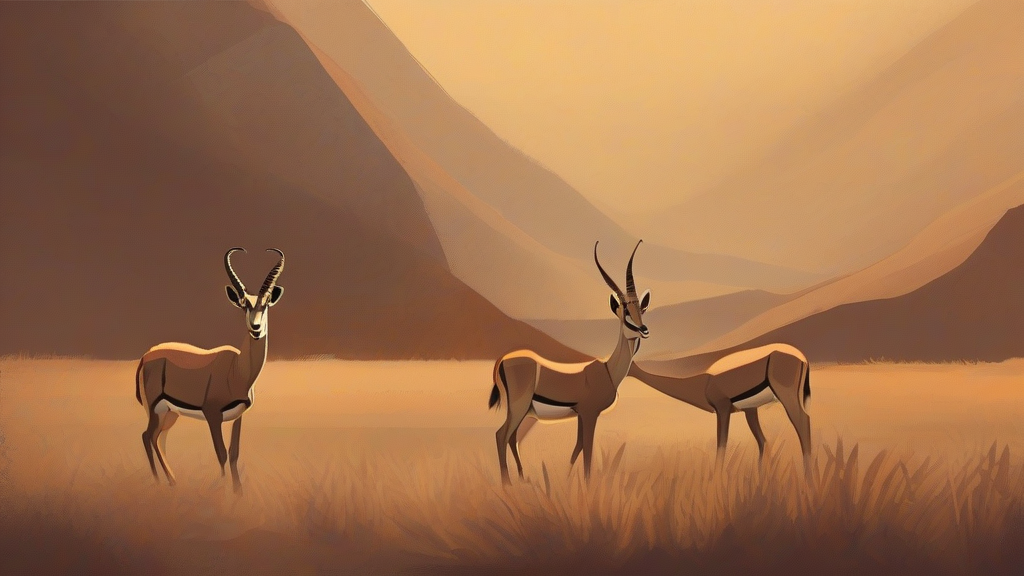
What does antelope mean?
An antelope is a swift, graceful, hoofed ruminant belonging to the family Bovidae, found mainly across the grasslands and savannas of Africa, with some species ranging into Asia. Antelopes are characterized by long, slender legs built for running, and most bear permanent, unbranched horns — present in both sexes in many species — which distinguishes them from deer, whose antlers are shed and regrown annually. The term 'antelope' is a loose, traditional grouping rather than a strict scientific category: it excludes cattle, sheep, and goats but embraces dozens of genera, from the tiny royal antelope to the large eland. In North America the name is popularly given to the pronghorn, which is in fact not a true antelope at all. The word evokes speed, elegance, and alertness, appearing frequently in descriptions of wildlife, hunting traditions, and heraldic emblems.
nounA swift-running, graceful ruminant mammal of the family Bovidae, native chiefly to Africa and Asia, typically having long slender legs and often curved or spiral horns.
- Any of various swift, horned ruminant mammals of the family Bovidae native to Africa and Asia, excluding sheep, goats, and cattle.
- In North America, the term is popularly applied to the pronghorn (Antilocapra americana), which despite the name is not a true antelope.
"A herd of antelope moved silently across the savanna at dawn."
"Cheetahs rely on explosive speed to bring down agile antelope on the open plains."
"The pronghorn antelope of Wyoming can sustain speeds no African predator could match."
The regular plural is 'antelopes'. Some style guides retain the unmarked plural 'antelope' for certain species, following old game-animal convention, but 'antelopes' is standard in general usage.
"Dozens of antelopes grazed along the riverbank."
The pronghorn 'antelope' of North America isn't a true antelope at all — it's the last survivor of an entirely different family, and it can outrun almost anything on Earth.
Reviewed by Deb Chak, Editor. AI-assisted content curated by RJS Tech Solutions LLP.
Etymology of antelope
The word entered English in the late sixteenth or early seventeenth century, borrowed from French antilope, which itself derived from Latin antalopus. The Latin form traces back to Greek antholops, an animal name used by ancient writers such as Pliny the Elder, though its precise origin within Greek remains uncertain. The English term was initially applied somewhat loosely to exotic horned beasts before settling into its modern zoological sense.
How antelope is actually used
The word covers a broad, informal grouping rather than a single scientific taxon; biologists usually refer to specific species (impala, kudu, springbok) instead of using 'antelope' generically. In everyday speech it connotes grace, speed, and leaping agility.
Easily confused with antelope
Deer belong to the family Cervidae and (except in some species) only males grow antlers that are shed yearly, whereas antelope are bovids with permanent horns in both sexes.
A gazelle is actually one particular group of small, slender antelopes, so 'gazelle' names a subset rather than a separate kind of animal.