What does anthill mean?
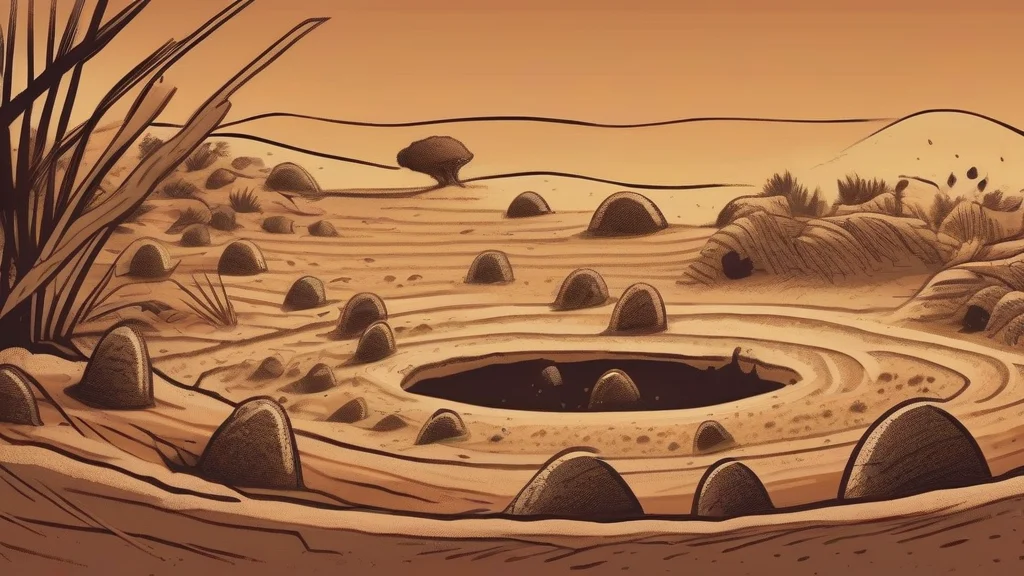
An anthill is the visible mound of soil, sand, or finely chewed plant material that ants heap around the entrance to their underground colony. As worker ants tunnel beneath the surface, they carry the excavated debris upward and deposit it in a distinctive cone, which may range from a few centimeters to well over a meter tall depending on the species. The word functions literally in natural history and everyday observation, but it also carries a productive figurative sense: describing any scene of ceaseless, scurrying activity as 'an anthill' evokes industriousness, crowdedness, and collective purpose. The phrase 'like kicking over an anthill' vividly suggests provoking sudden chaos or agitation. Neutral in tone and common in both British and American usage, anthill is a simple compound — 'ant' plus 'hill' — yet it captures one of nature's most recognizable structures and remains a staple of both scientific description and colorful metaphor.
A mound of earth or sand thrown up at the entrance of an ant colony's nest by ants excavating their tunnels below.
"A red ant stood guard atop the anthill, antennae twitching."
Sometimes spelled 'ant hill' in older literature, though the solid compound 'anthill' is now standard.
(Figurative) A place or situation characterized by frantic, swarming, industrious activity.
"The newsroom on election night was an anthill of ringing phones and shouting editors."
The standard plural follows regular English noun inflection; it is common when describing landscapes dotted with many colonies.
"The meadow was pocked with dozens of anthills, some nearly a foot high."
Kick over an anthill and you're not destroying a home so much as triggering one of nature's fastest reconstruction projects — the colony typically rebuilds it within hours.
Reviewed by Deb Chak, Editor. AI-assisted content curated by RJS Tech Solutions LLP.
Etymology of anthill
Anthill is a transparent English compound formed from 'ant' and 'hill,' both of Old English origin. 'Ant' descends from Old English ǣmette, while 'hill' comes from Old English hyll, a common Germanic word with cognates across Germanic languages. The compound itself arose in Middle English and has been in continuous use for centuries, with older sources occasionally writing it as two words. Its figurative use comparing bustling human activity to an ant colony developed naturally from the literal sense.
How anthill is actually used
Anthill is a neutral, everyday noun used in both British and American English, and it appears in both literal natural-history contexts and figurative descriptions of busy human environments. It is sometimes written 'ant hill' in older texts, though the closed compound is now standard.
Easily confused with anthill
A molehill is a similar-looking mound of earth pushed up by a burrowing mole, whereas an anthill is built by ants excavating their nest.
The formicary is the ants' entire nest structure, largely underground, while the anthill is just the visible mound at its surface.