
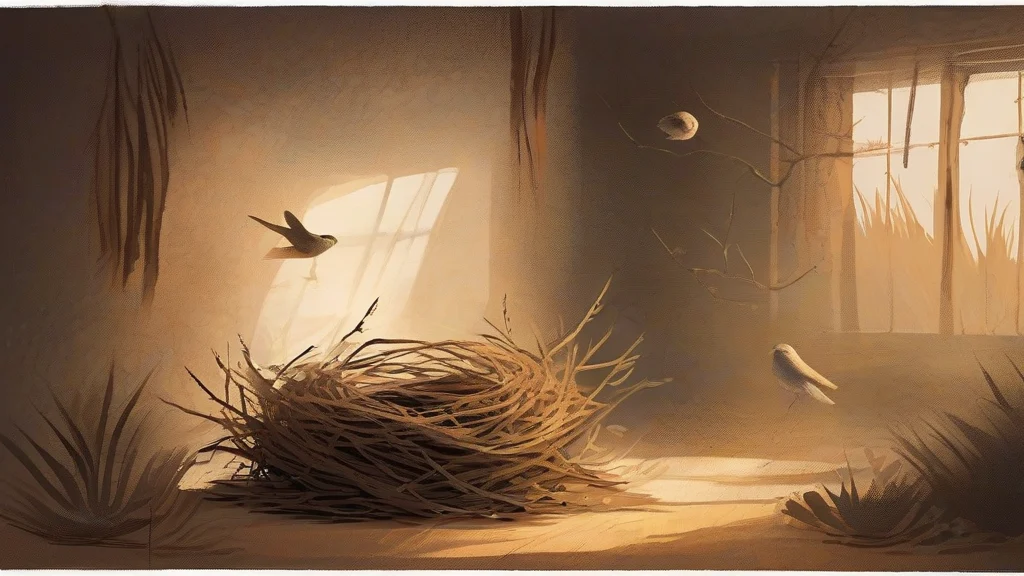
What does nest mean?
A nest is the shelter or home in which birds and other animals rest, protect their eggs, and care for their young. The word also describes a secure or comfortable place for people, often one that feels secluded or protected. In figurative use, a nest can refer to a cluster of objects or people gathered together. As a verb, to nest means to settle or fit snugly within a sheltered space, as in 'the village nestled in the valley.' The word is familiar, versatile, and especially effective in descriptive writing because it suggests warmth, shelter, family, and sometimes a place withdrawn from the outside world.
A structure or sheltered place in which a bird or other animal rests, protects its eggs, or raises its young; also, by extension, a comfortable or secluded place.
"The squirrel carried another acorn to its nest in the oak tree."
The figurative sense for a comfortable, secure, or secluded human dwelling is common in both spoken and written English.
To settle or fit snugly in a sheltered or comfortable place.
"The little village nestled between the hills and the river."
Usually used in the past participle or progressive forms, such as 'nestled' and 'nestling'; it conveys a sense of close, protected placement.
The standard plural of the noun is 'nests'.
"Several empty nests were visible in the reeds."
A nest can be both a home and a strategy: it shelters vulnerable eggs and young while giving their parents a base from which to defend them.
Reviewed by Deb Chak, Editor. AI-assisted content curated by RJS Tech Solutions LLP.
Where does nest come from?
The English word comes through Old English 'nest', from the Germanic root associated with sitting or resting in a sheltered place. Its deeper relatives include the Latin 'nidus', meaning 'nest', which underlies words such as 'nidification'. The English form developed into both a noun for an animal's home and a verb describing how something settles into a protected or snug position.
Related word forms
How nest is actually used
The noun is everyday and standard in British and American English. The verb is often used in the forms 'nestled' and 'nestling' and suggests fitting closely or settling in a protected place; it is common in descriptive writing.