
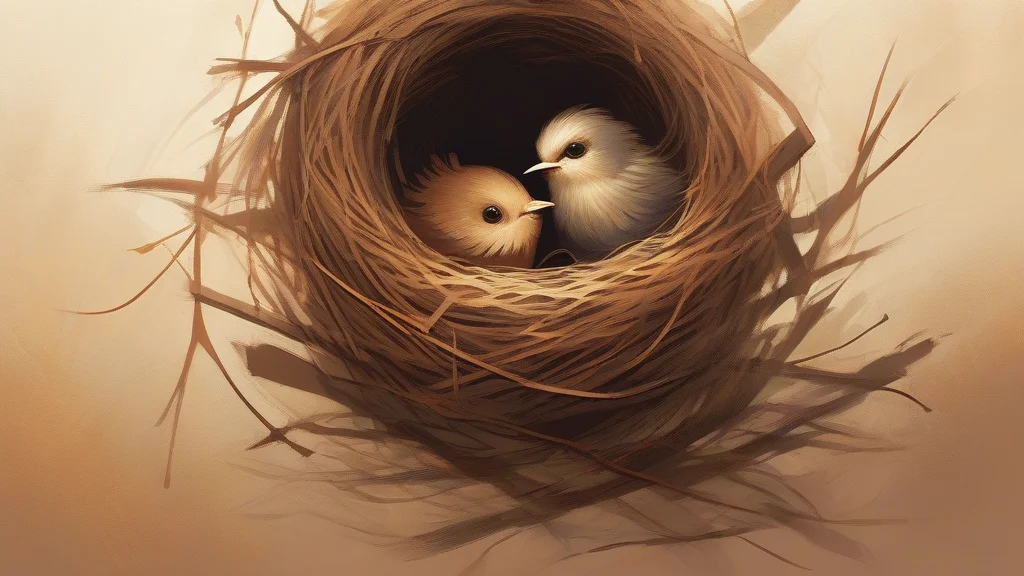
What does nestling mean?
Nestling most commonly names a young bird, especially one that is still in its nest or has only recently left it. As a countable noun, it is often paired with young and has a broader literary use: a person described as a nestling may be someone who remains close to home or, more figuratively, something snugly held within a family, group, or protected place. The word also appears as the present participle of nestle, as in a child nestling against a parent, although nestled is often more idiomatic in modern English. Nestling is especially useful when the important contrast is between a bird's dependence on the nest and the later, more mobile stage suggested by fledgling. A fledgling has developed enough to leave the nest and fly, whereas a nestling remains young and sheltered. The noun therefore carries a gentle sense of vulnerability, closeness, and beginnings, while its verb use evokes warmth and physical security.
A young bird, especially one that has not yet left its nest or has only recently left it. Figuratively, a person or thing closely sheltered in a home, family, or group.
"The fledged nestling prepared to leave the safety of its nest."
The figurative sense for a person is literary and may imply attachment to home or reluctance to leave a secure group.
The present participle of nestle: lying, settling, or pressing closely within or against something.
"The kitten was nestling in a patch of warm sunlight."
As a verb form, nestling is less common than nestled or the full verb nestle.
The regular plural of the noun; nestling is a countable noun.
"Two nestlings rested side by side in the nest."
Before a nestling spreads its wings, the nest is its whole world.
Reviewed by Deb Chak, Editor. AI-assisted content curated by RJS Tech Solutions LLP.
Where does nestling come from?
Nestling belongs to the Middle English nestle word family and has long been used for a bird associated with or remaining in its nest. Nestle comes from Old English nestlian, itself formed from the Old English word nest. The modern form also functions as a present participle of nestle, while figurative uses extend the image of shelter and close physical attachment beyond birds.
Related word forms
How nestling is actually used
The noun is countable and usually appears in a warm, literary, or descriptive context. Its figurative use for a person is literary and may suggest a close attachment to home. As a verb form, nestling is less common in modern usage than the alternatives nestle, nestled, or nestled.
Easily confused with nestling
As a noun, a nestling is a young bird; as a verb form, nestling is the present participle of nestle, meaning to snuggle or settle closely.