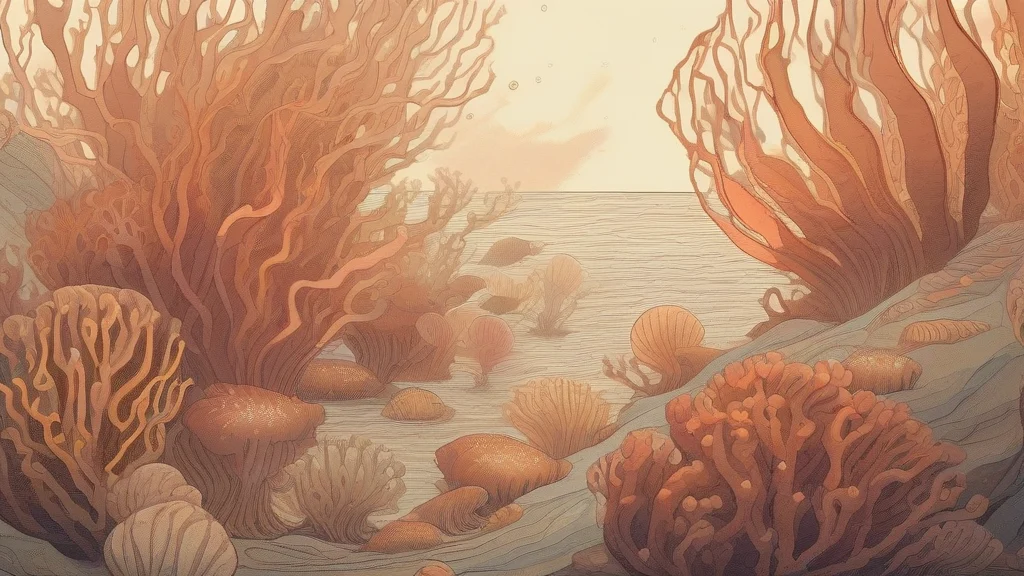
What does anthozoan mean?
An anthozoan is any member of Anthozoa, the largest class of cnidarians — the animal group that also includes jellyfish and hydrozoans. Anthozoans encompass corals, sea anemones, sea fans, sea pens, and their relatives, and they are defined by a distinctive life cycle: they exist exclusively as polyps, with no free-swimming medusa (jellyfish-like) stage at any point. Most anthozoans are sessile, attaching themselves to rocks, shells, or the seabed, and they capture food using rings of stinging tentacles surrounding a central mouth. Many species, particularly reef-building corals, live in symbiosis with photosynthetic algae called zooxanthellae, which supply them with nutrients and give reefs their striking colors. The word appears chiefly in marine biology, oceanography, and diving literature, where precision about cnidarian classification matters. Because anthozoans construct coral reefs — among the most biodiverse ecosystems on the planet — the term carries real ecological weight, connecting a technical label to some of the most consequential organisms in the ocean.
nounA marine invertebrate belonging to the class Anthozoa — sessile cnidarians such as corals, sea anemones, and sea fans that exist only as polyps and never develop a free-swimming medusa stage.
- An individual marine animal of the class Anthozoa, such as a coral, sea anemone, or sea fan, characterized by a polyp-only body plan.
"The reef's vibrant colors come from countless anthozoans, each hosting photosynthetic algae within its tissues."
"Biologists identified over forty species of anthozoan during the survey of the shallow lagoon."
"The sea anemone, like all anthozoans, anchors itself to rock and waits for prey to drift within reach of its tentacles."
Standard plural; used when referring to multiple individuals or species of the class Anthozoa.
"The tide pools were crowded with anthozoans, their tentacles swaying in the current."
Every coral reef on Earth is built by anthozoans — animals that spend their entire lives as polyps and never once swim.
Reviewed by Deb Chak, Editor. AI-assisted content curated by RJS Tech Solutions LLP.
Etymology of anthozoan
The word 'anthozoan' derives from the class name Anthozoa, itself built from Greek roots: 'anthos' meaning flower and 'zōion' meaning animal — literally a 'flower-animal,' a reference to the flower-like appearance of polyps such as sea anemones. The term entered scientific usage in the nineteenth century as naturalists formalized the classification of cnidarians. Its roots link it to a wide family of English words: 'anthos' also underlies 'anthology' and 'chrysanthemum,' while 'zōion' gives us 'protozoan,' 'metazoan,' and 'zoo.'
How anthozoan is actually used
Primarily used in scientific, marine-biology, and aquarium contexts rather than everyday speech; it functions both as a countable noun for individual animals and occasionally attributively (e.g., 'anthozoan tissue').
Easily confused with anthozoan
Hydrozoans belong to a different cnidarian class (Hydrozoa), which typically includes both polyp and medusa stages, whereas anthozoans exist only as polyps.
Anthozoa is the name of the entire taxonomic class, while an anthozoan refers to an individual animal within that class.