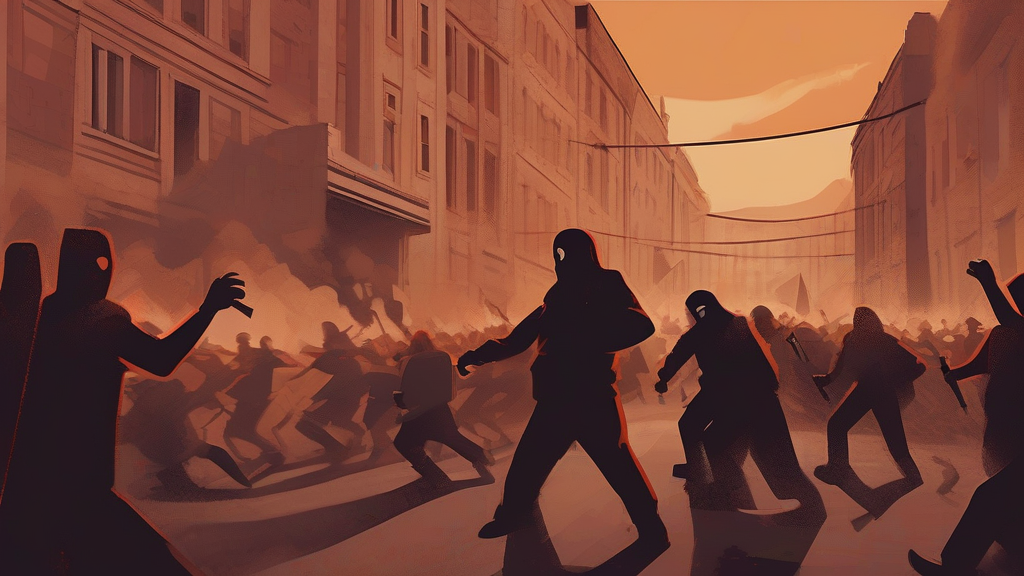
What does antifa mean?
Antifa refers to a decentralized political movement of activists who oppose fascism and other far-right ideologies, often through counter-demonstrations and direct action. The word can denote the movement collectively or, less frequently, an individual adherent. Its name derives from the German phrase Antifaschistische Aktion ('anti-fascist action'), used by communist-linked resistance groups in the early 1930s, with parallel roots in Italian anti-fascist organizing of the 1920s. Though long present in European political vocabulary, the term entered mainstream English-language discourse largely in the late 2010s amid high-profile street confrontations. Usage is politically charged: admirers frame antifa as a continuation of historical anti-fascist resistance, while detractors criticize its confrontational tactics. The word is typically left uncapitalized and takes no plural form, functioning as a mass or collective noun in most contexts.
nounA political movement or activist opposed to fascism and far-right ideologies, often engaging in direct action and counter-protests; also used collectively to refer to such militant anti-fascist groups.
- A militant anti-fascist political movement or its activists, typically opposing far-right groups through protest and direct action.
- An individual activist belonging to such a movement.
"The antifa counter-protesters gathered across the square from the far-right rally."
"City officials debated how to police clashes between antifa and far-right demonstrators."
"As a young man in 1930s Germany, he joined the antifa resistance to the Nazi rise to power."
Antifa normally functions as a collective or mass noun and does not take a plural form; individual members are referred to as 'antifa members' or 'antifa activists' rather than using a plural of the word itself.
"Several antifa were arrested at the demonstration."
The word 'antifa' is older than you might think — it traces back to German 'Antifaschistische Aktion' of the early 1930s, a resistance label born in the final years of the Weimar Republic.
Reviewed by Deb Chak, Editor. AI-assisted content curated by RJS Tech Solutions LLP.
Etymology of antifa
The word 'antifa' comes from German Antifaschistische Aktion ('anti-fascist action'), the name adopted by communist-led resistance groups in Germany in the early 1930s; related usage appeared even earlier in Italian anti-fascist circles of the 1920s. It combines the prefix 'anti-' with a clipped form of 'fascism', itself derived from Italian fascismo, from fascio ('bundle, group'), ultimately from Latin fasces — the bundle of rods carried by Roman magistrates as a symbol of authority. The term resurfaced in English-language media in the late 20th century and became widely familiar in the late 2010s.
Related word forms
How antifa is actually used
Usually written lowercase and uninflected; it functions as both a collective noun for the movement and, less commonly, a countable noun for an individual member. The term carries strong political connotations and is often contested in public discourse — supporters view it as anti-fascist resistance, while critics sometimes characterize its tactics as extremist. It gained widespread currency in English-language media in the late 2010s, though its history is much older.
Easily confused with antifa
Fascism is the authoritarian far-right ideology that antifa explicitly opposes; the two are adversaries rather than similar terms.