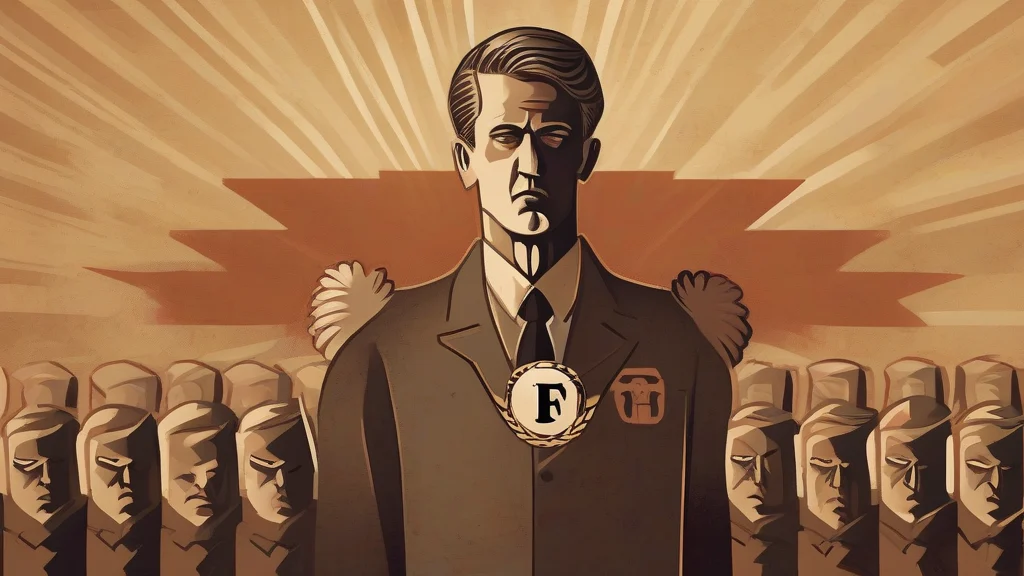
What does fascism mean?
Fascism is a far-right political ideology and form of government defined by extreme nationalism, a centralized dictatorship, and the forcible suppression of any opposition. Under fascist rule, individual liberties are subordinated to the state, dissent is crushed, and a charismatic leader is presented as the embodiment of the nation. The term derives from the Italian 'fascismo', rooted in the Latin 'fasces', a bundle of rods bound to an axe symbolizing strength through unity. Historically, it refers above all to Benito Mussolini's regime in Italy from 1922 to 1943 and its analogues, notably Nazi Germany, though Nazism is usually treated as a distinct movement. In everyday speech, 'fascism' is sometimes applied more loosely to any harshly authoritarian or oppressive conduct, a usage that critics consider imprecise. Because of its association with totalitarian violence, the word remains one of the most charged terms in political discourse.
nounA far-right, authoritarian ultranationalist political ideology and system of government characterized by dictatorial power, the forcible suppression of opposition, and strict control of society and the economy.
- An authoritarian far-right political ideology emphasizing ultranationalism, dictatorial leadership, and suppression of opposition, as historically exemplified by Mussolini's Italy.
- More broadly (often pejoratively), any system, regime, or behavior regarded as brutally authoritarian, intolerant, or oppressive.
"The historian traced how economic crisis and propaganda paved the way for fascism in interwar Europe."
"Fascism took hold in Italy after Mussolini's March on Rome in 1922."
"She warned that censorship and blind loyalty are the first steps toward fascism."
Rarely used; typically appears in academic writing when comparing distinct fascist movements across countries or periods.
"Scholars have studied the different fascisms that emerged across interwar Europe."
The word 'fascism' comes from the Latin 'fasces' — a bundle of rods tied around an axe that Roman officials carried as a symbol of power through unity.
Reviewed by Deb Chak, Editor. AI-assisted content curated by RJS Tech Solutions LLP.
Etymology of fascism
The word fascism comes from the Italian 'fascismo', formed from 'fascio' meaning 'bundle' or 'group', which traces back to the Latin 'fasces' — the bundle of rods enclosing an axe carried by Roman magistrates as an emblem of authority. It entered English in the early 1920s following Mussolini's rise to power. Related words sharing this root include 'fascist' and, more distantly, other English derivatives of the Latin 'fascis'.
Related word forms
How fascism is actually used
Because fascism is strongly associated with Mussolini's Italy and the atrocities of mid-twentieth-century regimes, calling something 'fascist' carries heavy negative connotation; scholars caution against applying the label loosely to any disliked policy or government. The word is normally uncapitalized when used generically but may be capitalized when referring to specific historical movements (e.g., Italian Fascism).
Easily confused with fascism
Fascism is a far-right ultranationalist ideology centered on the state and a single leader, whereas communism is a far-left ideology aiming for a classless, stateless society with collective ownership.