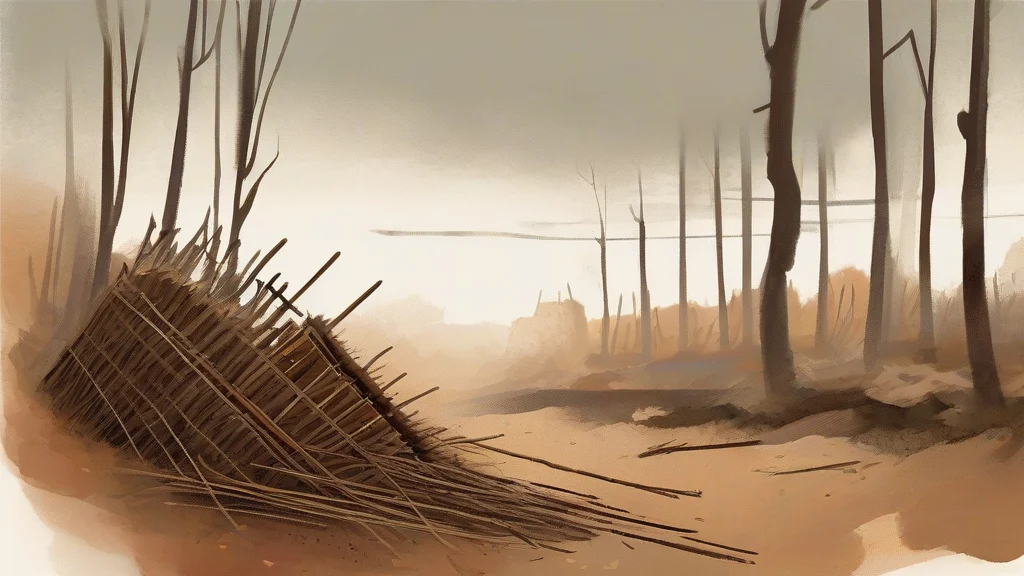
What does fascine mean?
A fascine is a long bundle of brushwood, sticks, or similar material bound tightly together and used in engineering work, most famously in siege warfare. Armies have carried fascines since at least the era of gunpowder fortifications: thrown into ditches or moats, they formed a crude ramp for attacking troops, while laid in rows they reinforced trenches and ramparts. Civil engineers adopted the device too, using fascines—often arranged as 'fascine mattresses'—to protect riverbanks from erosion and to create stable ground over soft soil. The word entered English in the early seventeenth century from French, ultimately deriving from the Latin fascis, meaning bundle, the same root that produced fasces and fascism. Today fascine survives chiefly in military engineering manuals, histories of fortification, and specialist discussions of hydraulic and geotechnical work—a compact reminder that some of warfare's most useful technology was little more than wood and rope.
nounA long bundle of brushwood, sticks, or similar material bound together, used in military engineering and civil works to fill ditches, strengthen earthworks, or provide a foundation on soft ground.
- A bound bundle of brushwood or sticks used to fill ditches, revet earthworks, or form foundations on soft ground, especially in military engineering.
"The engineers threw fascines into the moat so the assault party could cross."
"Sappers laid a fascine mattress across the marsh so the artillery could be hauled forward."
"Before the storm, the crew weighted the riverbank with fascines to slow the erosion."
The standard plural is 'fascines'; historical texts on Italian fortifications occasionally use the Italian plural 'fascine'.
"The pioneers stacked spare fascines along the parapet ready for the night's advance."
The same Latin root that gave us the word 'fascism' also gave armies the humble brushwood bundles they tossed into moats to cross them.
Reviewed by Deb Chak, Editor. AI-assisted content curated by RJS Tech Solutions LLP.
Etymology of fascine
Fascine was borrowed into English from French in the early seventeenth century, during a period when English military vocabulary absorbed many terms from continental fortification practice. Its source is the French fasciner in its older sense of binding into faggots, which derives from the Italian fascina (a bundle of sticks), ultimately from the Latin fascis, meaning a bundle or pack. That same Latin root gave Roman fasces—the bundled rods symbolizing magisterial authority—and hence modern words like fascism and fascia.
How fascine is actually used
A technical term found mainly in military engineering manuals, fortification history, and civil engineering contexts such as riverbank stabilization; rare in everyday speech. The plural is typically 'fascines', though the Italian-style plural 'fascine' may occasionally appear in historical texts about Italian fortifications.
Easily confused with fascine
Fascinate is a verb meaning to charm or captivate, while a fascine is a physical bundle of brushwood used in engineering works.