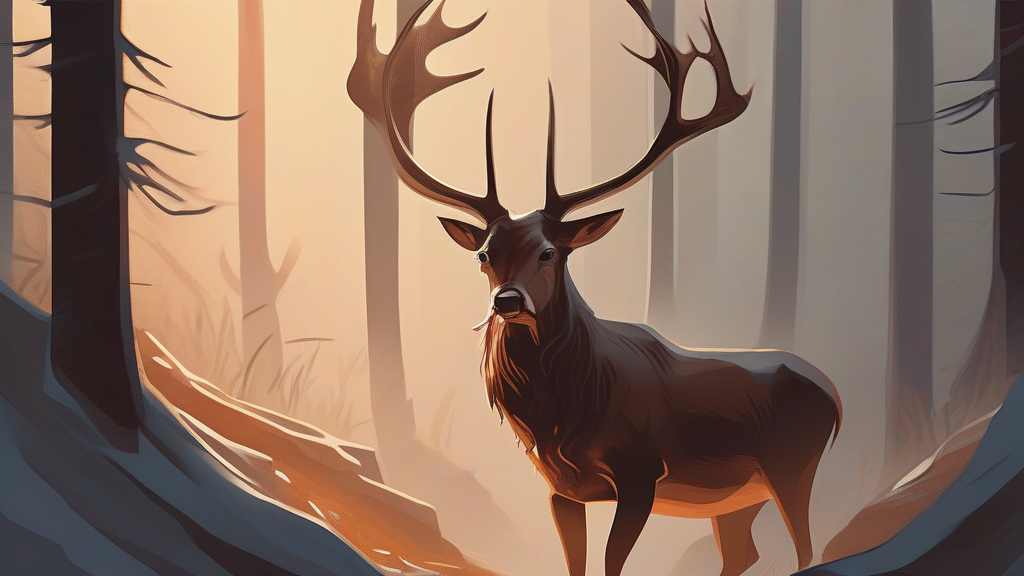
What does antler mean?
An antler is one of a pair of branched, bony appendages that grow from the skull of deer, most commonly on males of the species such as stags, bucks, bulls, and reindeer (in which females also grow them). Unlike horns, which are permanent and covered in keratin, antlers are made entirely of bone and are shed and regrown each year, making them unique among animal structures. During their growth phase they are soft and covered in a blood-rich skin called velvet, which is later shed as the bone hardens. The word appears frequently in hunting, wildlife, and natural-history writing, and it carries connotations of strength, virility, and wildness. Figurative uses exist but are limited — chiefly "locking antlers" to describe a contest between rivals. Antlers also hold practical value: shed antlers are gathered for dog chews, knife handles, furniture, and decorative art.
nounOne of a pair of branched, bony structures on the head of a deer, typically borne by the male and shed and regrown annually.
- A branched, bony outgrowth on the head of a deer, especially of the male, that is shed and regrown annually.
"The stag stood motionless at the forest's edge, the velvet still clinging to its new antlers."
"The bull elk's antlers spanned nearly four feet from tip to tip."
"Hunters often search the forest floor in late winter for antlers shed by bucks after mating season."
The plural "antlers" is the more common form in practice, since these structures occur as symmetrical pairs; the singular "antler" typically denotes one branch of the pair.
"Both stags had shed their antlers by early spring."
Antlers are the only mammalian organs that are fully regrown from scratch every single year — and they can grow up to an inch a day.
Reviewed by Deb Chak, Editor. AI-assisted content curated by RJS Tech Solutions LLP.
Etymology of antler
"Antler" entered English in the early 15th century, borrowed from Old French antoillier or a similar form, whose ultimate origin is uncertain — possibly related to Medieval Latin anteocularia, meaning "before the eyes," referring to the position of the first branch above the eye. The word replaced earlier Germanic terms for deer horn in English usage. Its development reflects the medieval French vocabulary surrounding hunting, which contributed many specialized terms to English.
Related word forms
How antler is actually used
"Antler" is used almost exclusively in zoological, hunting, and natural-history contexts. The word is countable; "antlers" refers collectively to both branches of the pair. It is standard in both formal and informal registers, though it is rarely used figuratively except in phrases like "locking antlers," meaning to clash or compete.
Easily confused with antler
Horns are permanent, unbranched structures with a keratin sheath found in cattle, goats, and sheep, whereas antlers are branched, made of bone, and shed and regrown annually by deer.