What does apothecary mean?
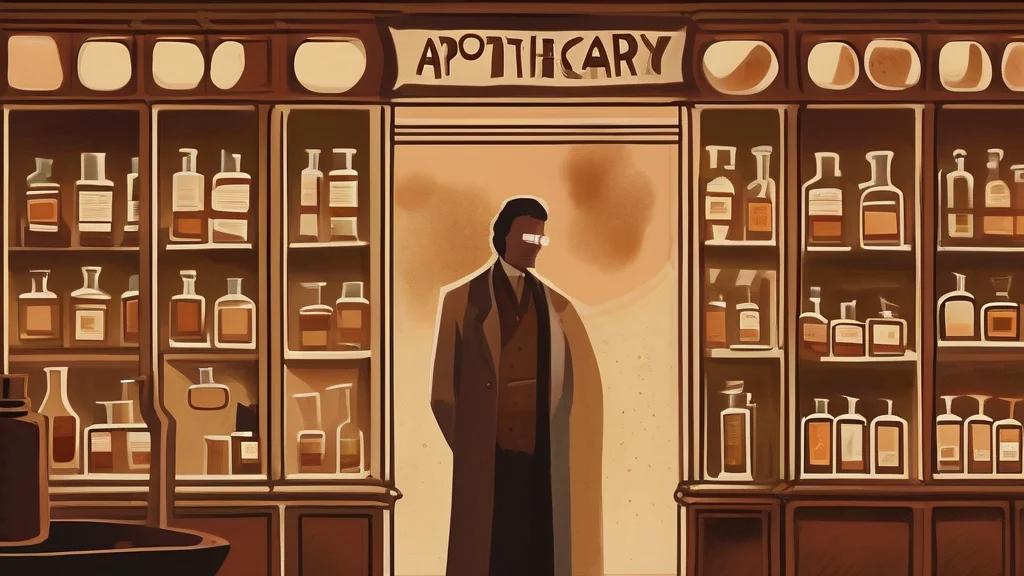
An apothecary was, historically, a person who prepared and sold medicines, operating somewhere between a modern pharmacist and a general medical practitioner. In medieval and early modern Europe, apothecaries compounded drugs from herbs and minerals, dispensed remedies, and frequently offered medical advice to customers who could not afford a physician. The word also denotes the shop itself, evoking images of dark wooden drawers, glass jars, brass scales, and handwritten labels. Today the term survives mainly in historical writing and as a fashionable label for boutiques selling herbal remedies, candles, and artisanal skincare, lending them an air of old-world craft. In Britain the apothecary was long regulated by the Society of Apothecaries, founded in the seventeenth century, whose members helped shape the modern pharmacy profession. Though obsolete as a trade title, the word remains useful precisely because of its rich associations with the history of medicine.
A person who prepared and sold medicines and drugs, especially in earlier centuries, often acting as a community's primary source of medical treatment.
"The apothecary weighed out powdered willow bark and wrapped it in paper for the farmer's feverish wife."
In historical British usage, apothecaries ranked below physicians and surgeons in the medical hierarchy.
The shop or premises in which medicines were compounded and sold; by extension, a modern shop trading on this image to sell herbs, remedies, or cosmetics.
"Tourists wandered into the restored apothecary, now a museum filled with original ceramic drug jars."
Standard plural following the regular '-y' to '-ies' pattern; note that 'apothecaries'' with an apostrophe also appears in the fixed term 'apothecaries' weights', the historic system of measures used by the trade.
"In the seventeenth century, London's apothecaries formed a powerful livery company that examined candidates for the trade."
The word 'boutique' and 'apothecary' are distant cousins — both trace back to the ancient Greek word for a storehouse.
Reviewed by Deb Chak, Editor. AI-assisted content curated by RJS Tech Solutions LLP.
Etymology of apothecary
Apothecary derives from the ancient Greek 'apothēkē', meaning a storehouse or repository, which passed into Latin as 'apotheca'. Medieval Latin used the term for a place where wine, spices, and eventually medicines were stored, and the word entered Middle English in the fourteenth century via Old French. The same Greek root ultimately produced the modern words 'boutique', 'bodega', and Italian 'bottega', all originally denoting small shops or storerooms.
Related word forms
How apothecary is actually used
The word is now largely historical or stylistic; in everyday British English 'chemist' and in American English 'drugstore' or 'pharmacy' have replaced it. It carries a quaint, old-world connotation, which is why modern herbal and cosmetics shops deliberately adopt the name.
Easily confused with apothecary
A pharmacy is the modern shop or profession of dispensing drugs, while an apothecary refers to the historical practitioner or shop that preceded it.
Despite the similar spelling, apotheosis means elevation to divine status or the highest point of something, and has no connection to medicine or shops.