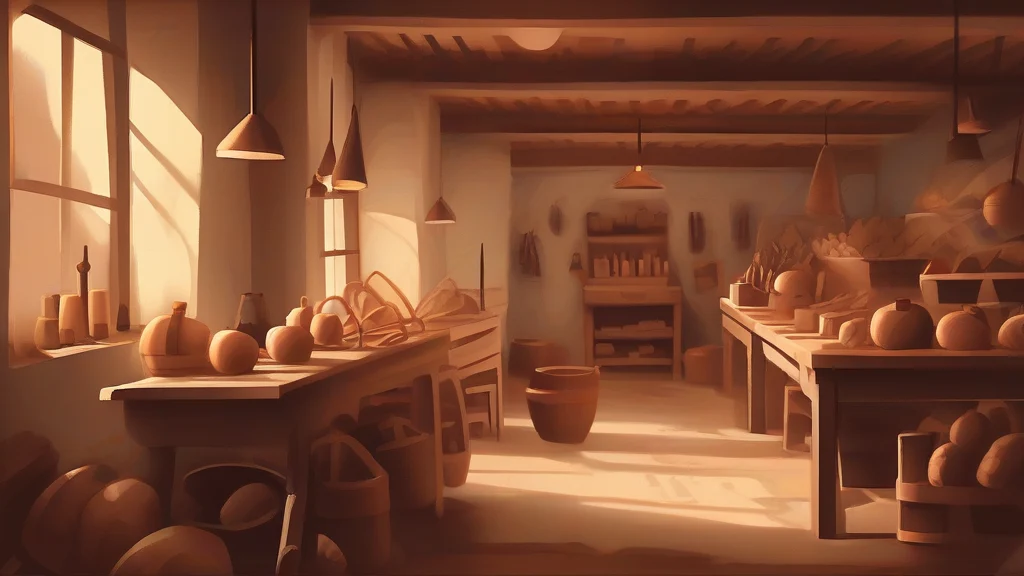
What does bottega mean?
A bottega is a workshop or studio, most famously associated with the great masters of the Italian Renaissance. In a Renaissance bottega, a painter or sculptor ran something closer to a commercial enterprise than a romantic creative retreat: apprentices and hired assistants prepared materials, painted backgrounds, copied designs, and helped complete commissions under the master's supervision. Young artists such as Leonardo da Vinci received their training in this system, learning technique by imitating and assisting their teacher. The word comes from Italian, ultimately tracing back through Latin to Greek, and shares a root with words like boutique and apothecary. Today bottega appears mainly in art history and in discussions of traditional craftsmanship, where it connotes hands-on skill, mentorship, and the collaborative production of fine goods.
nounA bottega is a workshop or studio, especially the shop or workplace of a master artist or craftsman in Renaissance Italy where apprentices worked under the master's direction.
- A workshop or studio of a master artist or craftsman, particularly in Renaissance Italy, where apprentices and assistants worked under the master's direction to produce artworks and commissions.
- More generally, any Italian artisan workshop or small craft business producing handmade goods.
"The young apprentice learned fresco painting in Verrocchio's bottega alongside Leonardo da Vinci."
"In Botticelli's bottega, assistants prepared panels and mixed pigments so the master could focus on composition."
"The leather goods are still made by hand in a small bottega outside Florence."
Bottega takes the original Italian plural 'botteghe'; an anglicized plural is not standard in careful usage.
"Florence in the fifteenth century was full of botteghe turning out altarpieces, chests, and gilded ornament."
Leonardo da Vinci didn't go to art school — he trained in a bottega, a bustling Renaissance workshop where apprentices ground pigments and copied their master's style until they could paint like him.
Reviewed by Deb Chak, Editor. AI-assisted content curated by RJS Tech Solutions LLP.
Etymology of bottega
Bottega is an Italian word meaning workshop or shop, borrowed into English primarily through writings on Renaissance art. It derives from Latin 'apotheca' meaning storehouse or repository, itself taken from Greek 'apotheke', which also gives English 'apothecary' and, via Old French, 'boutique'. The word entered English usage in art-historical contexts, where scholars adopted the Italian term to describe the master-apprentice workshop system of Renaissance Italy.
How bottega is actually used
Bottega is a loanword from Italian and carries an educated, art-historical register; it is most at home in writing about Renaissance art, craftsmanship, and luxury goods production. It retains its Italian plural form 'botteghe' rather than taking an anglicized plural. In modern usage it also evokes artisanal authenticity, partly through the influence of the fashion house Bottega Veneta.
Easily confused with bottega
An atelier is a French term for an artist's or designer's studio, while a bottega is the Italian equivalent with stronger connotations of a working craft workshop that produced goods commercially.