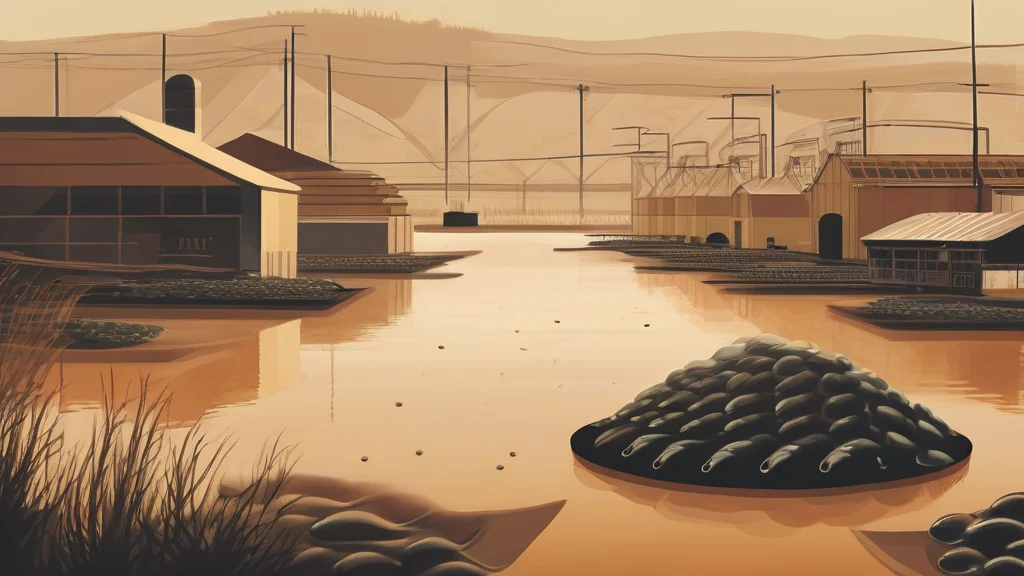
What does aquaculture mean?
Aquaculture refers to the breeding, rearing, and harvesting of aquatic organisms — fish, crustaceans, mollusks, and algae — in controlled or semi-controlled settings such as ponds, tanks, raceways, or net pens in coastal waters. It functions as a mass noun in English and carries a broadly neutral register, appearing comfortably in scientific literature, government policy, business reporting, and general journalism. As wild fish stocks have come under increasing pressure, aquaculture has grown into one of the fastest-expanding food-production sectors on earth, now supplying more than half of all seafood consumed globally. Its connotations are mixed: advocates present it as a sustainable answer to overfishing and food insecurity, while critics point to pollution, disease transfer to wild stocks, and habitat impacts associated with some intensive operations. Common adjectival partners include sustainable, marine, freshwater, and intensive. Related but narrower terms include mariculture, for farming conducted in the sea, and pisciculture, which refers specifically to raising fish. For anyone reading about food systems or ocean conservation, aquaculture is an essential vocabulary word.
nounThe farming of aquatic organisms such as fish, shellfish, and seaweed in controlled or semi-controlled environments, typically for food production.
- The commercial or subsistence rearing of aquatic organisms (fish, crustaceans, mollusks, algae) in ponds, tanks, cages, or coastal enclosures for food, restocking, or other products.
"Norway's salmon aquaculture industry supplies fish to markets around the world."
"The bay's sheltered waters make it ideal for oyster aquaculture."
"Rising demand for seafood has driven rapid growth in aquaculture over the past three decades."
Rarely pluralized; the plural appears only when referring to distinct practices or systems of aquatic farming in technical contexts.
"The report compared freshwater and marine aquacultures across the region."
More than half the seafood eaten worldwide is no longer caught in the wild — it was farmed.
Reviewed by Deb Chak, Editor. AI-assisted content curated by RJS Tech Solutions LLP.
Etymology of aquaculture
The word aquaculture is formed from Latin roots: aqua, meaning water, combined with cultura, meaning cultivation or tending, the same second element found in agriculture and horticulture. It is a relatively modern formation, coined in English during the twentieth century as the practice of farming aquatic species expanded commercially, though the practice itself dates back thousands of years to ancient Chinese carp ponds and Roman oyster cultivation. Its cognates share the cultura element, including agriculture and the broader English word culture, all ultimately tracing back to the Latin verb colere, meaning to till, tend, or inhabit.
How aquaculture is actually used
Aquaculture is a formal-to-neutral term used widely in science, policy, journalism, and industry; it is uncountable in general use. The narrower terms mariculture (farming in marine environments) and pisciculture (fish farming specifically) are specialist subsets rather than synonyms in everyday usage.
Easily confused with aquaculture
Agriculture is the farming of land-based crops and livestock, whereas aquaculture is the farming of aquatic organisms such as fish and seaweed.