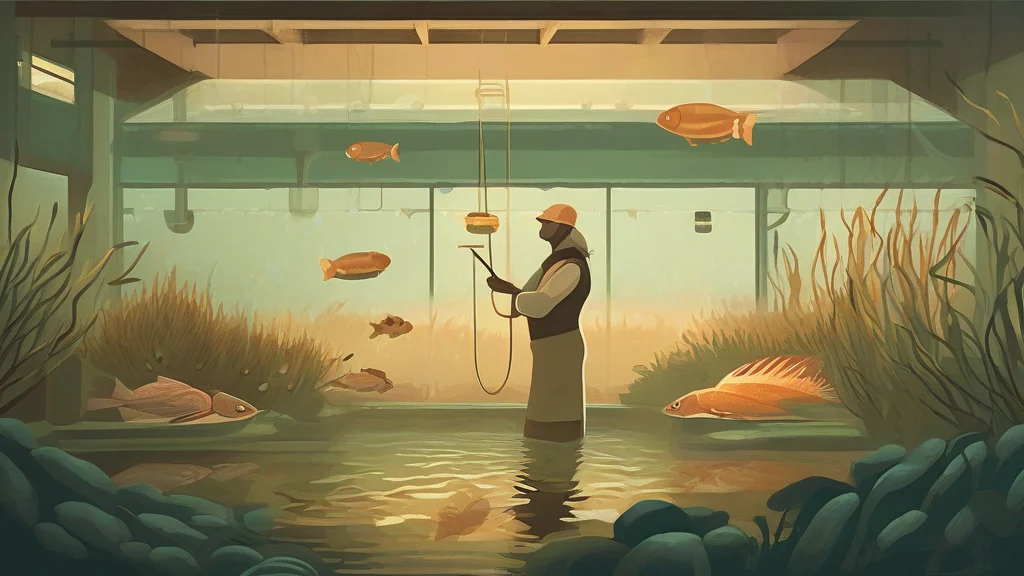
What does aquafarming mean?
Aquafarming refers to the practice of raising aquatic organisms — fish, shellfish, crustaceans, and aquatic plants — in controlled or semi-controlled water environments for human use, most often as food. It is essentially agriculture applied to water: instead of tending fields, practitioners manage ponds, tanks, coastal pens, or offshore cages where species such as salmon, tilapia, shrimp, oysters, and seaweed are grown to maturity. Aquafarming is closely related to, and often used interchangeably with, the broader term aquaculture, though the latter can also encompass non-food applications such as stock restoration and research. As global demand for seafood has grown and wild fisheries have reached their limits, aquafarming has expanded dramatically and now supplies the majority of seafood eaten worldwide. It carries both promise and controversy: advocates point to its efficiency and reduced pressure on ocean stocks, while critics raise concerns about pollution, disease, and effects on wild populations. The word appears most often in discussions of food security, sustainability, and marine economics.
nounThe cultivation of aquatic organisms such as fish, shellfish, and aquatic plants in controlled or semi-controlled environments, typically for food production; the practice of aquaculture.
- The commercial or subsistence cultivation of fish, shellfish, crustaceans, and aquatic plants in freshwater or marine environments for food and other products.
"Aquafarming now supplies more than half of the seafood consumed worldwide."
"Norway's salmon aquafarming industry exports fish to more than a hundred countries."
"Inland ponds in Southeast Asia have long relied on aquafarming to provide protein for local communities."
Rarely pluralized; the uncountable form is standard, since the word denotes an activity or industry rather than discrete countable items.
"Different regions have developed distinct aquafarmings suited to their local waters."
More of the seafood on your plate is farmed than caught — aquafarming quietly overtook wild fishing years ago.
Reviewed by Deb Chak, Editor. AI-assisted content curated by RJS Tech Solutions LLP.
Etymology of aquafarming
Aquafarming is a modern English compound formed from the Latin-derived element 'aqua' (water) combined with 'farming', reflecting its conceptual parallel with land-based agriculture. The Latin word aqua, meaning water, has given English a family of related terms including aquarium, aquatic, and aqueduct. The compound itself arose in the twentieth century as commercial fish and shellfish cultivation grew into a significant industry, alongside the slightly older and broader term aquaculture.
Related word forms
How aquafarming is actually used
Aquafarming is a common synonym of the broader term aquaculture, though some writers reserve 'aquaculture' as the umbrella term (including research and restoration uses) and use 'aquafarming' specifically for food-production contexts. The register is neutral to slightly technical; it appears frequently in journalism about food systems and environmental policy. When practiced in seawater it may be called mariculture.
Easily confused with aquafarming
Agriculture is the cultivation of land-based crops and livestock, whereas aquafarming specifically concerns raising organisms in water.