What does farming mean?
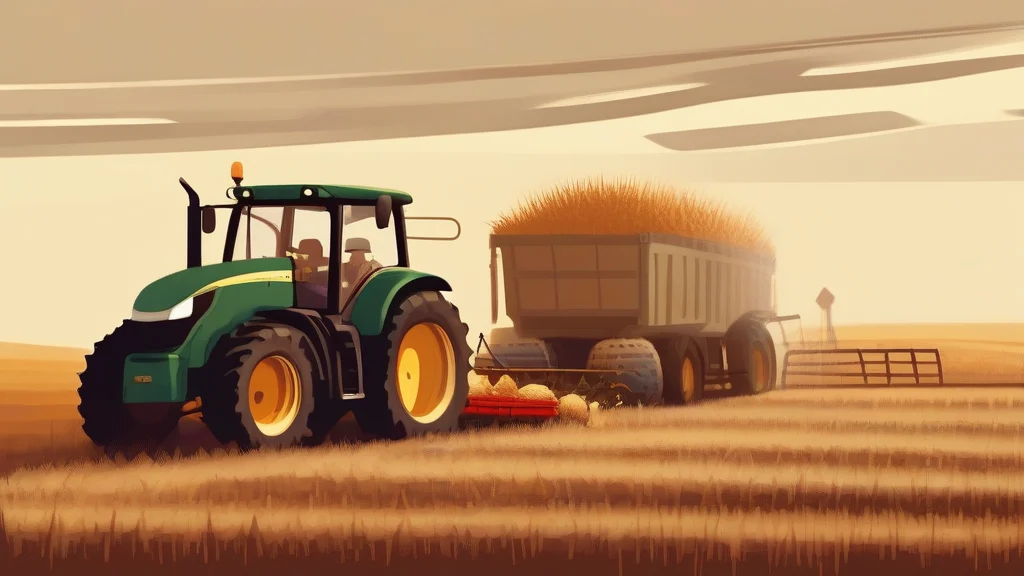
Farming is the practice and business of cultivating land, growing crops, and raising livestock for food, fibre, and other products. It is one of humanity's oldest and most consequential activities, marking the transition from nomadic hunter-gatherer life to settled societies roughly ten thousand years ago. In modern usage, the word covers everything from small-scale subsistence plots, where families grow just enough to feed themselves, to vast industrial operations producing grain, meat, and dairy at enormous scale. Farming frequently appears in fixed pairings such as 'organic farming', 'subsistence farming', and 'factory farming', which signal both method and philosophy; these terms carry strong connotations, evoking either environmental stewardship or criticism of intensive production. Beyond agriculture itself, the word is sometimes applied metaphorically to systematic harvesting or exploitation of any resource. Understanding farming means understanding not only an occupation but the foundation on which human civilisation, economies, and daily meals ultimately rest.
The activity or business of cultivating land, growing crops, and raising livestock.
"Farming remains the backbone of the region's economy."
Present participle of 'farm': engaged in the activity of running a farm, cultivating land, or raising animals.
"They have been farming the same fields for three decades."
As a verb form, 'farming' functions as a present participle or gerund rather than an independent word.
'Farmings' is rare and generally avoided; the uncountable singular 'farming' is used for all quantities, though different types may be referred to individually.
"Various farmings were practised across the region — dairy, arable, and mixed — though such phrasing is uncommon in modern English."
The word 'farm' comes from Latin 'firma' meaning a fixed payment — so for centuries, 'a farm' meant a lease contract, not a field.
Reviewed by Deb Chak, Editor. AI-assisted content curated by RJS Tech Solutions LLP.
Etymology of farming
Farming derives from the noun 'farm', which entered Middle English from Old French 'ferme', itself borrowed from medieval Latin 'firma', meaning a fixed payment or rent. Originally, a 'farm' denoted a lease or fixed sum paid for the right to work land rather than the land itself, and the modern sense of cultivated holdings developed from this contractual meaning. The root traces back further to Latin 'firmus' ('firm, stable'), making 'farming' etymologically related to words such as 'firm', 'affirm', and 'confirm'. The verbal form 'to farm' and derivatives like 'farmer' followed naturally as the sense shifted from payment to cultivation.
Related word forms
How farming is actually used
Farming is a common, register-neutral noun used in both everyday speech and technical agricultural writing. It often appears modified to indicate the type of production (organic, subsistence, intensive) and can carry connotations ranging from pastoral nostalgia to criticism of industrial practices depending on context.
Easily confused with farming
Pharming is a cyber-attack that redirects website traffic to fraudulent sites, whereas farming is the cultivation of land or livestock.