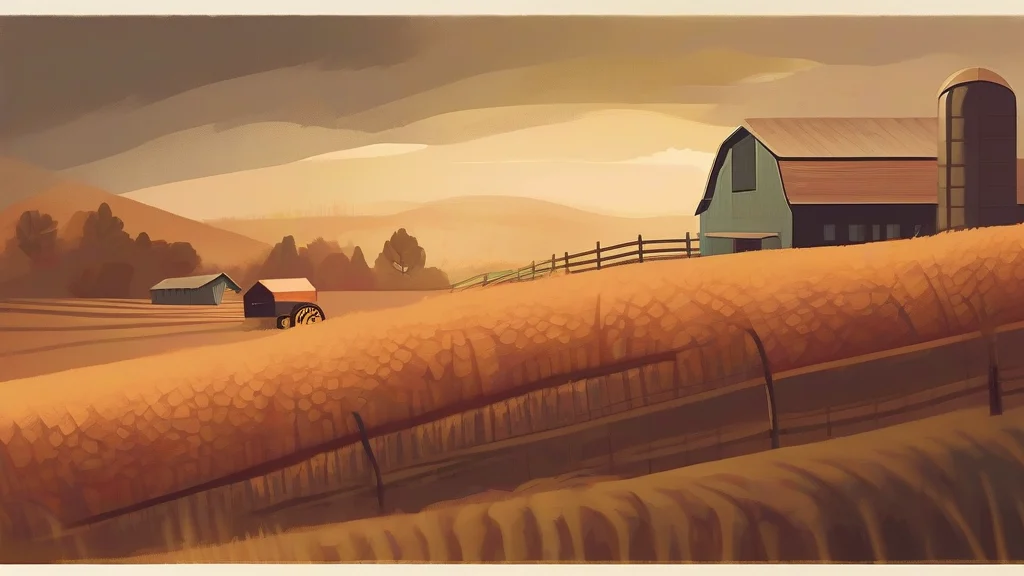
What does farm mean?
A farm is an area of land, together with its buildings and equipment, dedicated to growing crops or raising animals for food and other products. It ranks among humanity's oldest economic institutions: since people first domesticated plants and beasts roughly ten thousand years ago, farms have anchored settled civilization, shaping landscapes, diets, and societies. The word also functions as a verb, describing the act of cultivating land or breeding livestock, and it extends metaphorically to specialized production sites such as fish farms and wind farms. In modern usage, 'farm' evokes both the pastoral ideal of the family farm and the industrial reality of large-scale agribusiness, giving it connotations that range from nostalgic to commercial. Related phrases like farm-to-table and factory farm reflect ongoing cultural debates about how food should be produced. Understanding 'farm' means understanding not just a word, but the foundation of agricultural life and its enduring hold on the public imagination.
An area of land, together with its buildings, devoted to growing crops or raising livestock.
"The wheat farm stretched across the valley floor."
To cultivate land or raise livestock for food or other products.
"His family has farmed these hillsides for over a century."
The figurative use 'farm out' means to delegate work to others, sometimes implying unfair exploitation.
Standard plural form, used when referring to multiple agricultural holdings.
"Several small farms in the region have switched to organic methods."
Before the 16th century, 'farm' meant the fixed payment you owed — not the land itself; the word for rent became the word for rural life.
Reviewed by Deb Chak, Editor. AI-assisted content curated by RJS Tech Solutions LLP.
Etymology of farm
Farm derives from Old French 'ferme', meaning a fixed payment or lease, which itself comes from Latin 'firmissimum' via Medieval Latin 'firma', referring to a fixed rental agreement — ultimately rooted in the Latin adjective 'firmus', meaning firm or steadfast. The word entered Middle English in the medieval period still denoting a fixed sum payable as rent, typically paid by a tenant who leased land from a lord. By the 16th century the sense had shifted from the payment to the land itself, so that 'farm' came to mean the leased or owned holding under cultivation. Cognates include related terms such as 'fee' and 'fief', which trace back through feudal vocabulary of property and obligation.
Related word forms
How farm is actually used
The verb sense is standard in British English ('to farm sheep') but less common in American English, where 'raise' or 'grow' often substitutes. The phrase 'farm out' carries a mildly negative connotation of delegating work away, sometimes implying exploitation.
Easily confused with farm
A firm is a business enterprise or company, whereas a farm is land used for agriculture; the two share similar spelling but entirely different meanings.