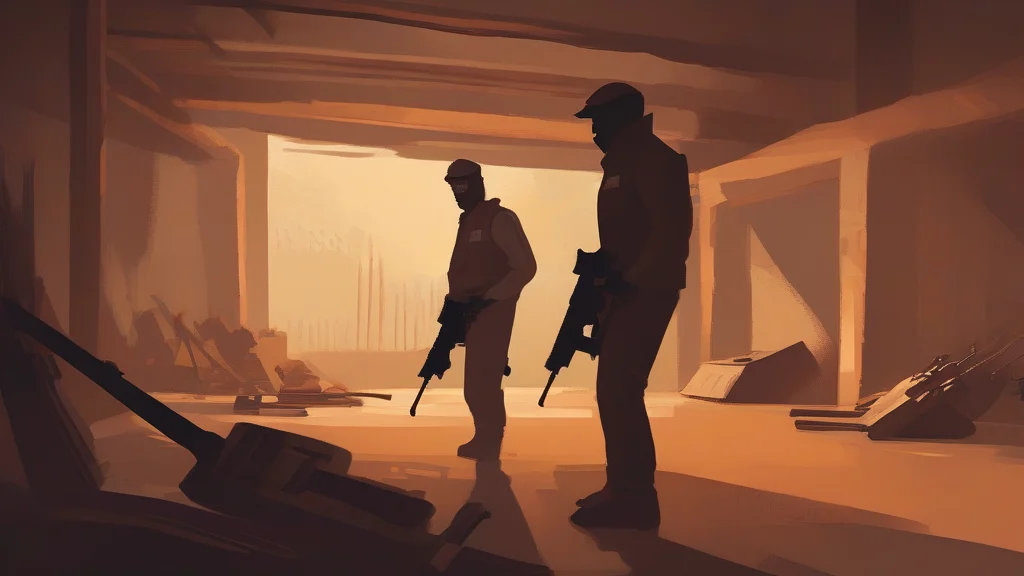
What does arming mean?
'Arming' is the act of equipping a person, group, or nation with weapons, most commonly appearing as the progressive form of the verb 'arm' — as when journalists report that a faction 'has been arming itself' ahead of a conflict. It can also function as a noun describing the process of weaponization itself, and in engineering it names the step at which a device such as a missile fuse or alarm becomes active and ready to fire. Because it sits at the center of debates over military aid, insurgency, and escalation, the word carries weighty, often ominous connotations: to speak of a country 'arming' is usually to imply preparation for war. Its roots run deep — the word descends from Latin 'arma' (weapons), the same source that produced 'armor', 'armada', and 'armistice'. Whether in headlines about proxy wars or in the fine print of munitions manuals, 'arming' signals that instruments of combat are being put into hands that will use them.
Equipping a person, group, or place with weapons or the means of defense.
"The peacekeepers watched anxiously as both sides continued arming along the frontier."
Almost always appears in progressive constructions such as 'is arming' or 'has been arming'.
The act or process of equipping with weapons; in engineering, the activation of a device such as a fuse or warhead so that it becomes ready to operate.
"The missile's arming occurs automatically once it clears the launcher."
The engineering sense is standard in ordnance and aerospace terminology but uncommon in everyday speech.
The same Latin root that gives us 'arming' also gave us 'armada', 'armistice', and 'armor' — one little word carrying two thousand years of warfare in its baggage.
Reviewed by Deb Chak, Editor. AI-assisted content curated by RJS Tech Solutions LLP.
Etymology of arming
'Arming' derives from the verb 'arm', which entered Middle English from Old French 'armer', itself borrowed from Latin 'armare' meaning 'to furnish with weapons', from 'arma' (tools, weapons). The same Latin root underlies a whole family of English words including 'armor', 'armory', 'armada', and 'armistice'. The participial form has been used in English since the medieval period, and its specialized technical sense in weaponry and fuses developed alongside modern ordnance.
Related word forms
How arming is actually used
Most often encountered as the progressive form of the verb 'arm' ('is arming', 'was arming'), typically in political and military reporting about conflicts. The technical sense — an 'arming' mechanism in fuses, missiles, or security systems — is common in engineering contexts but rare elsewhere. The word carries serious, often negative connotations because of its association with escalating violence.
Easily confused with arming
Harming means causing injury or damage, while arming means supplying weapons or equipment — they rhyme but are unrelated in meaning.