
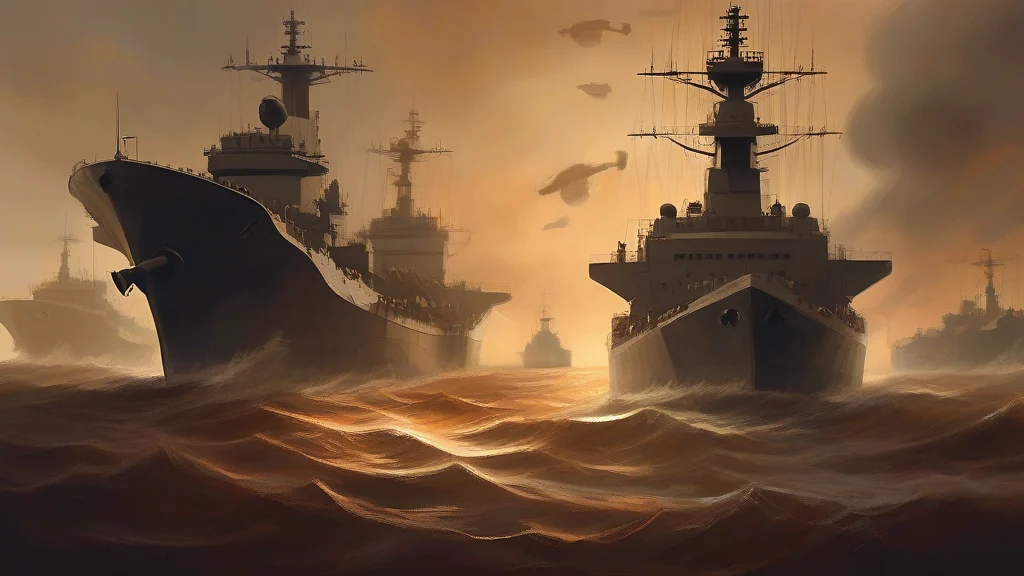
What does armada mean?
An armada is a large fleet of warships, originally in the sense of a naval force assembled for warfare. The word entered English from Spanish, where it derives from 'armada', meaning 'armed', and it is forever associated with the Spanish Armada of 1588 — the great fleet sent by Philip II against England that was famously scattered and destroyed. Today the term retains this historic resonance but has broadened considerably: journalists and writers use 'armada' figuratively to describe any imposing collection of moving things, from a convoy of trucks to a swarm of drones or a lineup of yachts. The word carries connotations of scale, power, and coordinated movement, giving ordinary descriptions a dramatic, almost cinematic quality. Whether evoking naval history or simply emphasizing sheer numbers, 'armada' remains a vivid and useful word for describing forces that arrive together in strength.
A large fleet of warships.
"The armada sailed in formation across the strait."
Frequently used figuratively today for any large group of vehicles, aircraft, or similar moving things.
By extension, any large group or force of moving things.
"An armada of food trucks lined the festival grounds."
Standard plural; used when referring to multiple fleets or multiple figurative groupings.
"Successive armadas were launched over the following decades."
The word 'armada' comes from Spanish for 'armed' — and the most famous one, Spain's 1588 fleet, was largely destroyed not by English guns but by storms and fireships.
Reviewed by Deb Chak, Editor. AI-assisted content curated by RJS Tech Solutions LLP.
Etymology of armada
Armada comes from Spanish 'armada', meaning 'armed (fleet)', ultimately from Latin 'arma', meaning weapons or tools of war. The word entered English in the early 16th century, well before the famous Spanish Armada of 1588 fixed it in the English imagination. It shares its Latin root with other military vocabulary such as 'armament' and 'armory'.
How armada is actually used
Often capitalized when referring to the historical Spanish Armada of 1588. In modern usage the term is frequently applied figuratively to any impressive mass of vehicles, aircraft, or people, which softens its original military connotation.
Easily confused with armada
An armadillo is a burrowing mammal with a bony armored shell, whereas an armada is a fleet of warships; the words merely share the 'armed' root in their origins.