What does cantata mean?
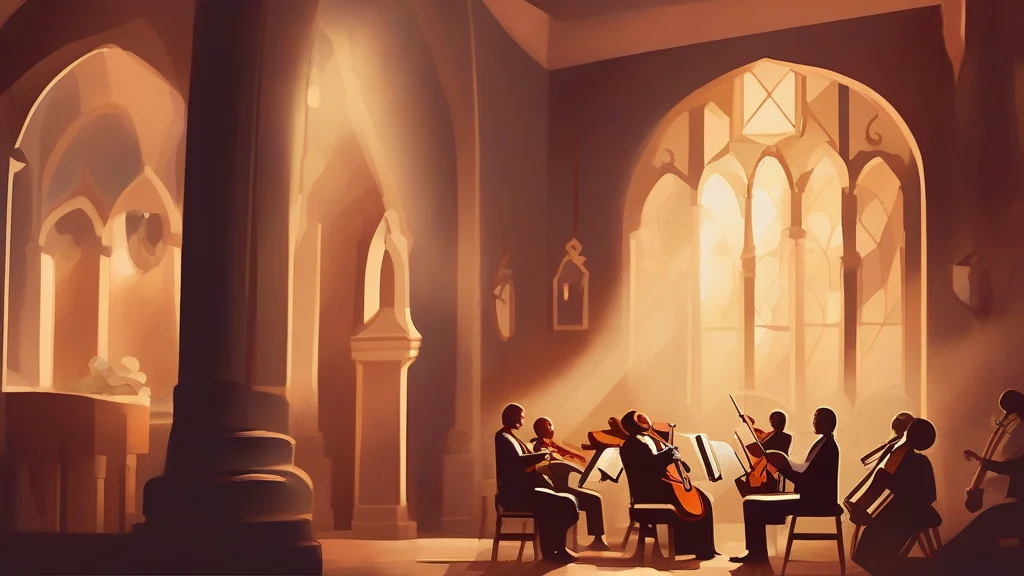
A cantata is a piece of vocal music written for singers and instrumental accompaniment, usually arranged in several contrasting movements such as recitatives, arias, and choruses. Unlike an opera, it is not staged: there are no sets, costumes, or dramatic action, and the story or devotional message is conveyed entirely through the music and words. Cantatas may be sacred, intended for church services, or secular, composed for private entertainment or public concerts. The form flourished in Italy during the early seventeenth century and reached its greatest heights in Germany, where Johann Sebastian Bach composed more than two hundred cantatas, many written for weekly Lutheran worship. Today the term most often appears in classical-music contexts — concert programmes, hymnals, and music education — and remains especially associated with church choirs performing seasonal works such as Christmas cantatas. For listeners, the word signals substantial but accessible choral music, shorter than an oratorio yet richer than a simple hymn.
nounA cantata is a musical composition for voices and instruments, typically in several movements, that tells a story or explores a theme without staging, scenery, or acting.
- A vocal musical composition in several movements for soloists, chorus, and instruments, usually without staging or costumes.
- (Historical) An earlier 17th-century Italian form of secular solo vocal music with continuo accompaniment.
"The choir rehearsed Bach's cantata for weeks before the Easter service."
"The school choir will perform a short Christmas cantata at the holiday concert."
"In his weekly duties at Leipzig, Bach produced a new cantata almost every Sunday."
The standard English plural adds '-s'. The original Italian inflected forms are rarely used in English writing.
"The festival programme featured three cantatas by lesser-known Baroque composers."
Johann Sebastian Bach composed over 200 cantatas — often writing one every single week for his Leipzig congregation.
Reviewed by Deb Chak, Editor. AI-assisted content curated by RJS Tech Solutions LLP.
Etymology of cantata
The word 'cantata' comes directly from Italian, where it was the feminine past participle of 'cantare', meaning 'to sing', and literally denoted a piece that was sung — as opposed to a 'sonata', a piece that was sounded on instruments. The term emerged in Italy in the early seventeenth century to describe secular vocal works with continuo accompaniment. It shares its Latin root, 'cantare' (a frequentative of 'canere', 'to sing'), with related English words such as 'chant', 'cantor', 'incantation', and 'canto'.
How cantata is actually used
The word carries a formal, classical-music register and appears mostly in concert programmes, music criticism, and religious contexts. The standard English plural is 'cantatas'; the Italian plural form 'cantati'/'cantate' is occasionally encountered but not idiomatic in English.
Easily confused with cantata
An oratorio is a longer large-scale choral work, usually on a sacred narrative subject, while a cantata is generally shorter and more intimate in scale.
A sonata is a composition for one or more solo instruments alone, whereas a cantata is written for voices, typically with instrumental accompaniment.