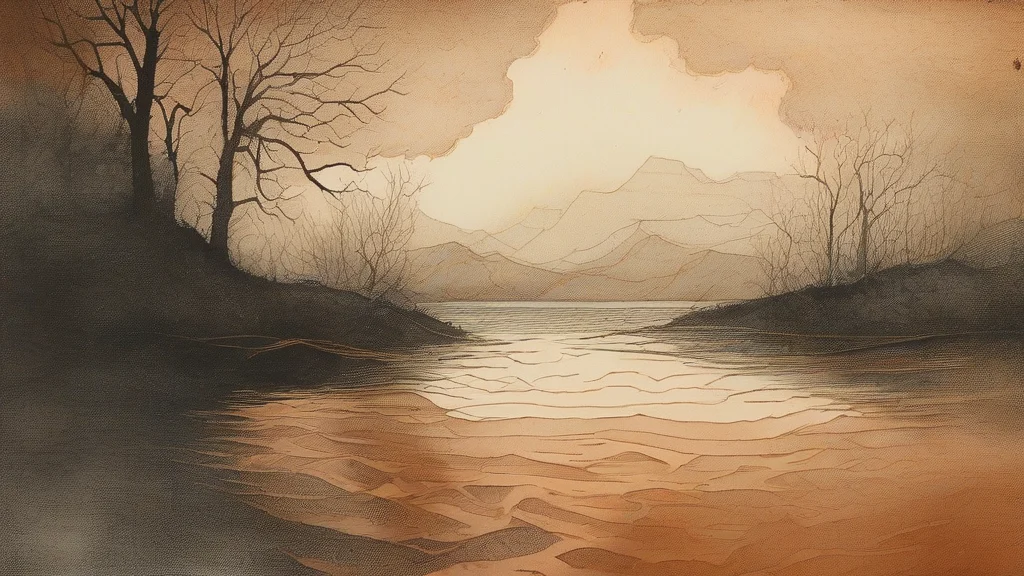
What does aquatint mean?
Aquatint is an intaglio printmaking technique used to create areas of tone rather than line, producing prints that resemble ink or watercolor washes. The process involves dusting a copper plate with fine rosin powder, which is then heated so the particles adhere; when the plate is immersed in acid, the acid bites around the resin grains, yielding a pitted surface that holds ink in subtle gradations. Developed in the mid-eighteenth century, aquatint was embraced by artists such as Francisco Goya, whose dramatic use of shadow remains among the most famous examples of the medium. The word also refers to an individual print made by this method. Today aquatint survives as a living craft practiced by printmakers and is a staple term in art history and connoisseurship, prized for the atmospheric, painterly effects it makes possible on metal.
An intaglio printmaking process in which tonal effects are achieved by etching a rosin-dusted plate with acid; also, a print made by this process.
"She studied the aquatint closely, admiring how the acid had rendered the storm clouds in velvety grey."
When referring to the technique, aquatint is usually treated as uncountable ('to work in aquatint'); when referring to an individual print, it takes normal plural forms.
To apply or work in aquatint on a printing plate.
"The printmaker aquatinted the background to soften the composition's hard outlines."
This verb use is technical and relatively rare, confined mainly to discussions of printmaking practice.
Used when referring to multiple individual prints made by the aquatint process; the technique itself is not pluralized.
"The exhibition featured thirty aquatints spanning the artist's entire career."
Goya's darkest nightmares were printed with powdered tree resin and acid — a technique called aquatint that made metal plates behave like watercolor.
Reviewed by Deb Chak, Editor. AI-assisted content curated by RJS Tech Solutions LLP.
Etymology of aquatint
The word aquatint derives from French 'la manière d'aquatinte', combining Latin-derived 'aqua' (water) with 'tinta' or 'tinctus' (dyed or tinged), reflecting the technique's aim of imitating watercolor washes. It entered English in the late eighteenth century, coinciding with the method's rise among European printmakers. Its components connect it to other words built on the Latin root for water, such as aquatic and aquarium, and to the family of 'tint' words derived from Latin tinctus.
Related word forms
How aquatint is actually used
Aquatint belongs to the specialized vocabulary of printmaking and art history; it appears rarely outside those contexts. It functions as both a countable noun (a print) and an uncountable noun (the technique), and can occasionally be used as a verb meaning to work in aquatint.
Easily confused with aquatint
Mezzotint achieves tonal effects by roughening the entire plate with a rocker tool, whereas aquatint uses acid-etched rosin dust to create its gradations.
Etching produces linear images drawn through an acid-resistant ground, while aquatint produces tonal, wash-like areas of shading.